If you heard me on the phone without knowing anything about me or without seeing my profile picture, you’d probably think I was a sure front runner to play Elle Woods in the musical adaptation of Legally Blonde.
For all intents and purposes, I “sound white”.
I’ve sounded like this my entire life, even when I was a child growing up in the Virgin Islands.
Out of all of my siblings, I am the only one without a recognizable Caribbean accent. If I’m around the right people – my friends and family from the islands or other Black people from other islands – sometimes I sound similar but, it doesn’t happen all that often.
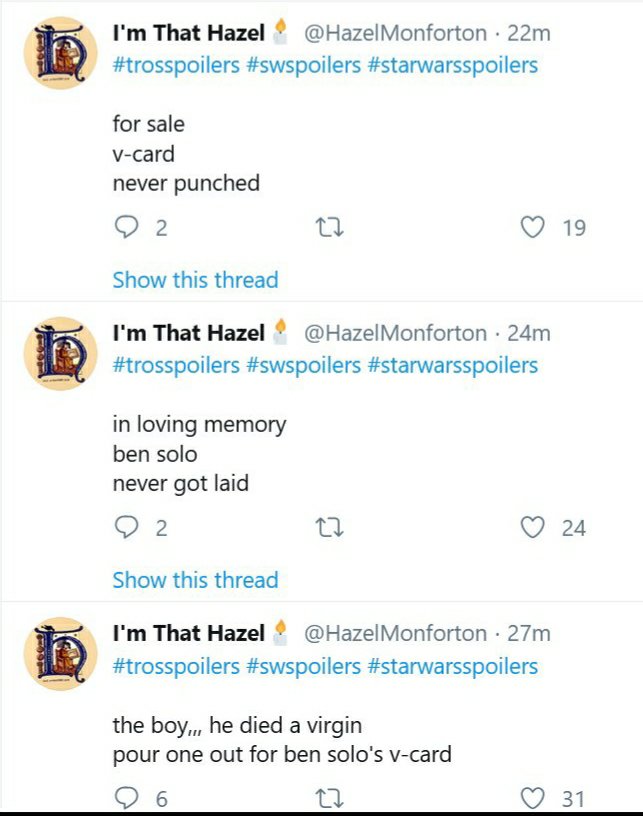
The day after the premiere of Star Wars Episode IX: The Rise of Skywalker (December 16, 2019), I watched a roughly seventy-second-long video of a young woman absolutely losing it over the idea that Kylo Ren – I’m sorry, Ben Solo – probably died a virgin.
I mean, she went on a whole tear about how this was actually about fighting for abuse survivors in the fandom to see someone like them make it to the end of the franchise (hello, Finn exists, binches) but like… at the end of the day, her real big beef with The Rise of Skywalker days before it actually got a wide release was that… Ben Solo didn’t get to plow Rey’s oh so fertile fields before becoming one with the Force.
That sentiment – that Ben Solo somehow deserves to get his dick wet in Rey and that The Rise of Skywalker somehow robbed him of the right to fuck when it’s obvious that he’s the ultimate Space Incel – is featured heavily across too much of that fandom’s response to the end of the film.
There’s something that I’ve learned about what fandom racism looks like across 2019.
Something that makes me think about the future of fandom and my input/output as we inch towards 2020.
Fans of color – especially Black fans – who talk about racism and race in fandom are systematically rewritten in and excised from fandom in order to reframe conversations about race/race in fandom until the only people who are allowed to discuss race and racism in fandom are PIckMe POC who bend the knee to whiteness in fandom and white people who aren’t staying in their lane either way .
Yesterday, I saw one of my (white) mutuals talking about racism in fandom and the importance of listening to fans of color with someone (possibly a fan of color themselves) who seemed receptive to an extent. Thing is? I couldn’t see the tweet… because the person my mutual was talking with had me blocked.
I’d never once interacted with this person. I don’t know this person.
They definitely don’t know me.
But they know about me –
Apparently.
Enough to block me without actually ever bother engaging with me or my work outside of someone else’s screenshots – probably.
This happens literally all the time these days. People will block me in droves – usually because I am critical about racism in fandom, but one time when I said that it wasn’t racist to affectionately refer to Yoongi from BTS as a goblin or gremlin – without me ever once interacting with them.
And the thing is that I don’t expect anyone to let me run roughshod across their timelines. Half of the time, if I’m on one of my other accounts and I see my own content, I find myself getting annoyed. And I wrote those damn tweets.
If you’re out here claiming that you really care about racism in fandom but you and your friends have all knowingly blocked and/or constantly subtweet me, the most vocal Black voices in transformative fandom talking about racism in fandom and you pretty much only listen to sycophants of color who want to cling to their space in your orbit, –
It’s impossible to miss that I’ve spent most of 2019 writing about, listening to, and talking to other people about Korean pop and hip hop music. I have spent so much time, energy, and effort talking about what is now my primary fandom and at the end of these past eight months –
I can’t say that I regret any of it.
Criticism is part of my fandom way.
I love critical conversations about fandom. I love making connections between the theories I learned in grad school and the things I love. I genuinely and truly love getting my critical little claws all over something that I’m fond of.
This was originally posted on Patreon in November without any real extra-text.
One of the most interesting (and frustrating) things about talking about fandom and media and the racism present in these spaces is how many people view my position as one that has any power in fandom.
Note: This essay contains critical references to and some descriptions content in fanworks that is/seen as objectionable including underage characters and sexualized/eroticized racism.
I spent a lot of my time in graduate school arguing that “literature” as a word could encompass entire worlds of media that were consistently dismissed as not being sacred or classical enough.
I found the potential for literature in pretty much everything that had text in it and made a point of challenging the expectations that my classmates had about lit on a regular basis.
So I get that urge to be like “fan fiction should be as valued and as valid as literature” and I even embrace it – up to a point.
And that point comes when you look at the differences between how literature and fanfiction are critiqued. Or rather – how we’re allowed to engage critically with them.Read More »
Few fandoms fill me with the kind of anger that the Star Wars fandom does.
In fact, there are times where I’d go so far as to say that I hate it.
Times like Wednesday night.
When I got home Wednesday night from my first A.C.E concert, I was flying high. It’d been a great night with fantastic music and a stellar performance. Everywhere I looked, I saw fans loving their thing and loving that they got to share that thing with other fans. For a few blissful hours, I’d experienced fandom at its best: people coming together in joy and in celebration over something brilliant.
And then I was rudely reminded that the Star Wars fandom exists and that a whole huge chunk of the Rey/Kylo shippers who dominate much of the fandom discourse is made up of just really terrible people.
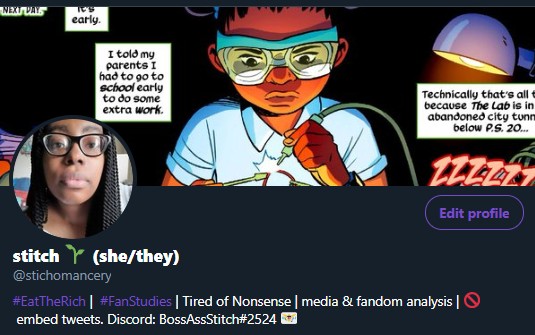
There’s nothing about my Twitter account that clearly pings the mind and calls me out as an obvious fan of K-pop – or… pretty much any form of nerdery outside of a single comic.
My profile picture is a picture of my face, not a Korean artist or a superhero. My display name and @ aren’t a fandom in-joke. (Although the little leaf/tree emoji in my display name is a reference to Kim Namjoon of BTS. I did it for his birthday in September and then… just never changed it.)
I do get that the only notably nerdy thing about my twitter account is, at first glance, my header image of Lunella Lafayette from Marvel Comics’ Moon Girl & Devil Dinosaur. And if you don’t know anything about her comic, it’s easy to assume it’s not nerdy.
But between my apparently invisible fannishness and my very visible Blackness, no one ever assumes I know anything about K-pop. Or Star Wars. Or fandom.
The first thing is my thing, you know?
I’m into a ton of different fandoms and when faced with having to try and choose one to represent fully across my Twitter profile, I kind of froze and chose one thing. So that inability some fans have to recognize me based on my profile and whatnot? That’s on me.
But then there’s the thing where Black people aren’t necessarily read as fans across many different fandom spaces around the world.Read More »
I’m just so pleased about how well “hood cosplay” as a term works for my needs across my project on antiblackness in the k-pop industry and its fandom spaces. I had to do a video!
Back in in the beginning of April, when I first started this project and the idea for this section started to take form, I screenshot and shared a tweet from a K-pop fan (though the group they preferred, escapes me) that said:
“I don’t know why black people are even stupid enough to like K-pop. It isn’t for you. Go listen to rap.”
Go listen to rap.
Imagine having the nerve to tell Black fans to “go listen to rap” because – in this case – you were frustrated by yet another conversation about cultural appropriation in the K-pop industry.
Imagine being that much of a walnut that you zoom on past the fact that even the cutesiest of girl groups will have something that’s attempting to be a rap line and rap breaks in their songs – specificallyso that you can tell Black people to get the hell out of “your” fandom space/genre of choice.
This is just a taste of what international fandom spaces are like for Black K-pop fans on social media. When we are even a tiny bit critical of the way our idols try to emulate our cultures, folks tell us that we need to get out of the fandom because there’s no way that we belong.
They tell us to return to rap music, the same rap music that our favorite idols and artists are listening to and performing in South Korea.
The original thread is here but I have blocked tons of people to maintain my boundaries so I have copied the tweets over here for ease of access for people who still want to see the tweets but can’t because I’ve blocked them for whatever reason.
Like I absolutely get the sentiment behind “all fanfiction is okay” but I also have seen many antiblack stories across my lifetime in fandom where black characters are abused/objectified/enslaved/torn down usually by/for white characters-
And those stories AREN’T okay, friends. Like the sentiment “all fanfiction is okay” (like it’s fine, don’t worry about it, women are making it so let them have their fun) is one of those Lil Fandom Things that makes me wonder…
Do people realize that they’re leaving out a lot of people in those sentiments?Read More »
First of all, Ming Na Wen plays Melinda May, not May Parker. (May Parker, by the way, is Peter Parker’s alternate universe daughter…) I got my Marvel wires crossed because I was multi-tasking on something while I recorded this! My bad.
The title is a bit of a misrepresentation. I actually talk about a single moment in the podcast that kind of disrupted my ability to enjoy what I was listening to 100% (It dropped down to like… 89.78%, not gonna lie.) and then I talked about the casual antiblackness I’ve been noticing from popular Korean and Korean American bloggers in the past year as I’ve worked on my project and how often it comes up with media criticism.
At the end of the day, it’s not like I was expecting a single person on this podcast to talk about East Asian antiblackness or antiblackness in general. So I’m not actually trying to place my own burden of responsibility on them. But I feel like it was a bruise on an otherwise genuinely awesome episode because there was no need to zero in on Black Panther in the way they did, I feel like… it wasn’t a great moment and it was unnecessary on top of that.
Honestly, the episode is across the board good, but it’s like… that moment threw me off my groove so solidly that well… Yes, I made a 36 minute long podcast episode about a moment in someone else’s podcast.
Here’s the link to the episode of The Tablo Podcast I’m talking about!
From GoTranscript! [Editing is still in progress, but I wanted to post it.]
Welcome to the inaugural episode of Stitch Talks Ish.
This is a mini-podcast that I’ll be doing on my website public content that is available to everyone who subscribes or just shows up on my website and listens to my content. This first episode of Stitch Talks Ish is subtitled “Stitch talks about The Tablo Podcast episode on racism”. Really, it’s that I’m going to talk about a moment in the podcast, not the whole thing. I’m an infrequent listener of other podcasts because I do listen to them, I work in marketing, so there are times where it is literally just reasonable to pop my headphones in and put on a good podcast and just enjoy other people going about their lives.
Tablo of Epik High is a really good podcast. It’s really
entertaining, really solid guests, really good introspection. It’s a good
podcast listen to while you’re at work and I’ve been in and out, so a couple of
episodes behind, but the 15th episode came out today, it looks like. Eddie, Nam
and Eric Nam who is on his own podcast with Spotify for K-pop was on and they
were talking about racism and it was just honestly really funny because it was
like, “Well, we don’t want to talk about K-pop. We’re going to talk about
something light and fun. We’re going to talk about racism.” It was an
hour-long almost. It was about 54 minutes long according to Spotify on my end.
Eric was like, “Are you serious?”
Honestly, I really love that
they brought hilarious notes to this topic because obviously somebody who
writes and talks about racism in fandom and in media, my experiences with
dealing with racism as a queer black person in America, I find it really
fascinating and really helpful when other people talk about racism and bring up
how it shapes our lives and just put a little light into it, in the situation’s
we go through and the kind of poke fun at experiencing racism honestly, so it
is a good episode.
If you stop here, that’s all you need to know. If you keep going, honestly, there was- one and a half moments across the podcast that pinged me.
Over the past three years, I’ve documented multiple people who’ve used real world (offline) politics and historic and present atrocities to silence claims of dissent and derail criticism across different fandom spaces.
Police brutality, extrajudicial executions of people of color, and the school to prison pipeline are just a few examples of what people consistently repurpose across fandom in order to stop the critical ball from rolling.
Back in May 2019, I wrote an audiopost script about “Real Racism” in fandom and how people use the idea of “real racism” to derail people talking about racism in fandom spaces – which apparently can’t ever have racism in its borders.
To many people – who aren’t exclusively white members of fandom – the racism that many other people see and discuss in fandom spaces doesn’t count as “real racism”. Identifiable racism, to them, involves immediate physical pain to a real person of color, hate crimes, or traceable harassment from people saying clearly that they’re harassing someone because of their race.
To them, because much of what fans of color have detailed as fandom racism don’t involve those easily identifiable aspects that mark racism as a thing that only outsiders to fandom commit, they can’t acknowledge that fandom racism is real racism.
My appearance on Jinjja Cha was kind of destined to happen. I
adore Girl Davis immensely and want to be as cool as she is one day. And while
I haven’t had the chance to talk with April yet, we’re both longtime Rain and
Miyavi fans so like… we’re clearly also soulmates separated at
birth.
So, this was in the cards as a Thing That To Take Place.
Talking with Girl was an incredible experience in terms of
like… how it felt like just going out with a buddy and getting intense over
drinks. (One day, by the way, I’m going to have that experience with them. I
promise y’all that.)
Girl and I talked about a lot of different things across
our almost three-hour-long conversation. From my whole issue with that one
barbershop that was all over social media for a few days to that time I was
friends with a white supremacist in college a decade ago, nothing was really
off limits?
And I loved it.
The main question across our conversation was about finding
our thresholds as Black fans invested in these groups and this industry that
has repeatedly shown itself to be incredibly antiblack across the past twenty or
so years.
One of the things I’ve been thinking about – especially after reading and sharing Stan’d off by Claudia Williams – is how hard is is to unstan?
Even temporarily because you’re burnt out or frustrated by a member’s hood cosplay or upset at the way the performers/their companies never seem to notice antiblackness in their fandoms – but can leap to quash a dating rumor in a heartbeat.







 Stitch's Media Mix

You must be logged in to post a comment.