This is a trailer for the next season of Stitch Talks Ish… where I talk with y’all!
If you’re interested in being a part of this upcoming season, send me a DM on Twitter or email me at contact@stitchmediamix.com!
Transcript
Stitch Talks Ish… With Y’all: Season Two Trailer
I had a lot to say in 2020, and god did I say all of it. Last year, I did 10 episodes of Stitch Talks Ish that rounded out to about six hours of content and covered a wide range of experiences. I did a fairly large amount of Korean pop and hip hop content – I did two episodes for BTS’ Map of the Soul ON:E concert -, negative and positive fandom experiences, nostalgia, and sharp conversations about antiblackness in and out of fandom.
One of the most infuriating things about urban fantasy as a genre is that one of the most familiar representations for Black readers (and of Black people) comes in the form of the magical Negro figure.
The Magical Negro is the white man’s idealized version of black people—a cross between faithful slave servant who walks with his head down and a superhero too conservatively demure to wear a cape and too grateful for the benevolence of white people to slit their throats for past atrocities. He may drop his “r’s” and use incorrect subject-verb agreement (because a literal incarnation of the perfect black stereotype, by definition, can’t be smart), but he is the incarnation of the friendliest, most loving, loyal dream of a human being.
And that’s the heart of it: magical negro characters literally exist to serve (usually, but not always) white characters on their quest to great magical power.
They exist to use their magical talent (which sometimes isn’t even actual magic but uncanny ability to be exactly what the white protagonist needs to fix themselves) and provide education to prepare the naïve non-black protagonist for magical success. Unless you’re lucky, there’s rarely any attempt at fleshing out the magical negro character or acknowledging either his talent or blackness beyond what those things can bring the hero.
Tweet thread originally posted on main this morning. Turned into a lightly edited (for clarity) blog post because I recognize that a lot of people were caught up in blockchain and have no way to then let me know that…
Let’s talk about racism in The Archive – again. Not just the AO3 but the idea that archives are judgment free and therefore bias free and everything SHOULD go and be hosted/archived… Including objectively harmful and RACIST content.
Recently, @dhifantasy posted about how the latest AO3 update was about image embeds… When everyone else is at least once again pretending to care about moderation and racism in User Generated Content and their TOS.
For the purposes of this thread/post: fandom = generative/transformative fanwork creating spaces including the hybrid music fandom spaces of idol fandom AND to a lesser extent gaming/cosplay fandoms which are seen as Outside Communities
CAN WE TALK ABOUT RACISM IN FANDOM AFTER A COUP ATTEMPT IN THE US?
No.
Because while the people involved WERE racist, connecting their online radicalization with the radicalization possible in fandom spaces is WRONG and trivializes real issues. After all, it’s not like there are real racists in fandom who seem to enjoy harming POC in fandom… They’re not looking to recruit or anything… Right?
Speculative fiction around human mating cycles and otherworldly physiology date as far back as the mid-20th century, but in recent years, the omegaverse has spawned from writers in the Supernatural fandom. It’s since spread across the fannish world, appearing everywhere from the Overwatch fandom to the Marvel Cinematic Universe.
What makes A/B/O so interesting isn’t just its out-of-the-box premise but how it challenges our understanding of human bodies and physiology in order to create deep, lore-rich erotica narratives. Just as the sci-fi writers of the 20th and 19th century encouraged us to rethink the present by looking to the future, A/B/O reshapes our grasp on sexuality in everyday life.
Ana Valens’ insightful writing on sex, kink, gender, and different internet sub/cultures has been a true highlight of 2020 for me. I have learned so much from her work! Ana is also a delight to speak with and so when I saw her talking about Omegaverse and looking for people to talk to, y’all know I was there. I’ve spoken about it a ton, but Omegaverse has actually become one of my favorite tropes/settings in fandom – as a writer and reader – and so I was happy to be one of the sources tapped for this incredible primer!
A lot happened in 2020. While it’s been one stressful year, it’s also been a year where I’ve pretty much stayed booked and busy and writing. So for those of you who aren’t super duper online, here’s what you’ve missed in terms of content, milestones, and strange or stressful things.
Aside from the kiss-and-dissolve, the majority of their intimate moments are fight scenes. Which is fine if you personally view fighting as foreplay but the whiteness leaps out about a fandom that sees violence – including kidnapping and the threat of torture – as a precursor of romance, but clearly reciprocated affection between Finn and Rey as uncomfortable… for her and for them.
It doesn’t matter that for Rey/Kylo shippers, The Rise of Skywalker provides more fanservice than an A.C.E. concert.
Because while they’ve gotten ninety nine percent of what they wanted from the franchise, they didn’t get the big thing that they really wanted:
Kylo Ren’s redemption in the form of an utterly unearned Happily Ever After where Ben and his tradwife Rey pop out little Skywalker spawn to perpetuate the Skywalker family’s genetics and their shitty legacy.
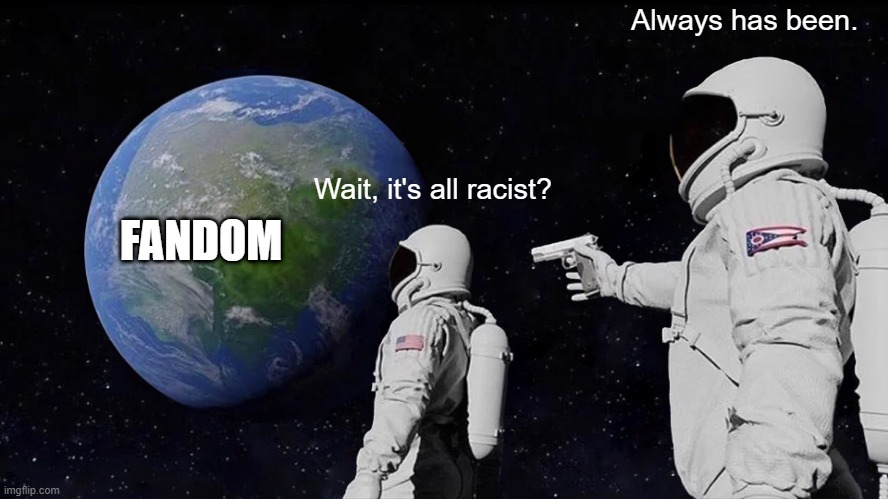
The “always has been meme” with the earth representing fandom and the first astronaut asking “wait, it’s all racist?” with the second astronaut holding the gun and saying “always has been”.
Fandom has always been racist.
All fandoms.
Even your fandom, whatever it may be.
Both because there are no fandoms that are actively anti racism by default and because the shape of fandom discourse in 2020 is that folks are actually super comfortable with being racist in defense of fandom. You can go back to transformative fandom at its birth and guess what’d be there… lots or racism.
In Greek mythology, Cassandra was a princess who got the god Apollo to give her the gift of prophecy but, when she refused to sleep with him (her end of the “deal” according to multiple sources), she was cursed to utter true prophecies that were never believed as that came through with devastating consequences.
Over the years, I’ve realized that many Black people in fandom (including performers and showrunners, not just fans) are treated similarly where they signal or even shout about a problem in fandom or with the source media… but no one listens until it’s too late and they can’t continue to ignore us… or it becomes somewhat profitable to pay attention to what’s been bothering or harming us for years.
The tweets and DMs I got were from both Black fans and non-Black fans, all shouting because finally we had further explicit confirmation of somethings that I and other Black people had been talking about years: the way that the Sequel Trilogy put Finn’s arc on the back burner on purpose to focus on Kylo/Rey AND the antiblackness aimed at John from fandom (as a whole) harmed him.
It’s the “they’re the same picture” meme with the panel on the left saying “Amy Cooper lying and saying that Christian Cooper threatened//tried to assault her in her two 911 calls” and the right panel saying “white women in fandom saying that Black people in fandom talking about racism in fandom are abusive/toxic/bullies who have actually harmed them by having these convos” over yellow text that reads “corporate needs you to find the differences between this picture and this picture” with the bottom panel saying: “they’re the same picture”.
I already made the Amy Cooper comparison back in June in Why Write About Fandom Racism At A Time Like This? where I talked about what the racism in the supposedly progressive queer/women run fandom spaces looks like:
It looks a lot like… Amy Cooper calling the cops on Christian Cooper and pretending that her life was in danger when all he wanted her to do was leash her damn dog, actually.
(And before you accuse me of “trivializing real racism” or whatever the actual fake woke set is calling it these days, understand that what Amy did and what the nice white women of fandom do are the same kind of behavior and they all weaponize their white womanhood for the same end: a permanent silencing of Black voices that they don’t like or agree with. I get to make comparisons like that considering that I’m subject to Amy Coopers in and out of fandom.)
I was right then and I am right now: there are white women and queer people in fandom who utilize their marginalization (womanhood or queerness, sometimes a blend of both with a splash of mental health issues and claims of trauma inspiring totes valid lashing out thrown in) in fandom.
They use their ability to inspire ATTACK-PROTECT urges in folks in the same way that Amy Cooper tried to utilize her white womanhood to get the cops to come in guns ablaze to protect her from… Christian Cooper’s nerdy ass asking her to put her dog on a leash.
The goal in fandom, as with Amy Cooper and various other cop-calling, hysteria weaponizing Karens, is to control who gets to speak, who is listened to, who is taken as an inherent threatening presence trying to control or harm others… and who should be.
I asked my wee niece Meems to fill y’all in on what she’s been watching and rewatching across 2020 (since I’ve just been bouncing between Love O2O and Romance is a Bonus Book) and the baby came through! Here are five dramas that my smallest nieceling has been circling across the year and some of the reasons why she liked them!
Summary: Park Seo Joon plays an arrogant boss to Park Min Young. One day she tells him that she’s going to resign, after that he tries everything he can to make her stay.
What I Like About It: There is a lot of character development, you can see how some of the characters grow as people. This show does have some dark scenes, but it’s mostly light-hearted and funny moments. The romantic scenes were adorable and the OST was really nice as well.
In the biggest and most popular series, the main characters are either outright law enforcement – like my book bae Peter Grant in the Rivers of London series – or they’re like Anita Blake, characters who don’t actually have badges worth anything but are set up as The Law in their neck of the woods.
I’ve read dozens of urban fantasy books in my lifetime and many of the books hinge very closely on these main characters in law enforcement or who are adjacent to law enforcement or… who have very close relationships with cops.
One thing I genuinely hate because of fandom is “[Black Character who is obviously under developed] hooks up two of their clueless white friends and gets them to realize their love”
Because the Black characters are never written out beyond how they can help the white folks. Eve gets Bond/Q together. Sam gets Steve/Bucky together. Rhodey gets Steve/Tony together. Finn gets Rey/Kylo together.
The second I see a story where a Black character is turned into a sassy romance guide for a white ship, I just… get so pissed? Because THAT reduces them/us.
Fandom: We love [Black Character] so much! He’s a fandom favorite!
Also fandom: *really only creates content for [Black Character] that views them shallowly, relies on racial and sexual stereotypes, literally reduces them, and/or uses them to get a white ship together.*
You must be logged in to post a comment.