Why Does The MCU Do That With Their Villains?

(Please don’t take this too seriously. I beg of you.)

I’m watching Age of Ultron as I write today and I need y’all to understand that this movie is really just keeping me going because James Spader as Ultron is unfortunately My Thing. But what this movie makes me think of – aside from how bad Whedon’s writing is from start to finish – is how the MCU often frames the reasonable negative backlash to the Avengers and the superpowered US Military Interventionalism they represent as The Ultimate Villainy.

In Age of Ultron, there are murals and graffiti in Sokovia that are against the Avengers and US intervention on their behalf. Because Hydra (who are Nazis, not even Nazi coded or inspired like the Empire or First Order in Star Wars) are the folks spurring the backlash to the Avengers, the hatred is framed as irrational and evil –

But at the end of the day: no one wants US interventionism except those that profit from it.

Read More »

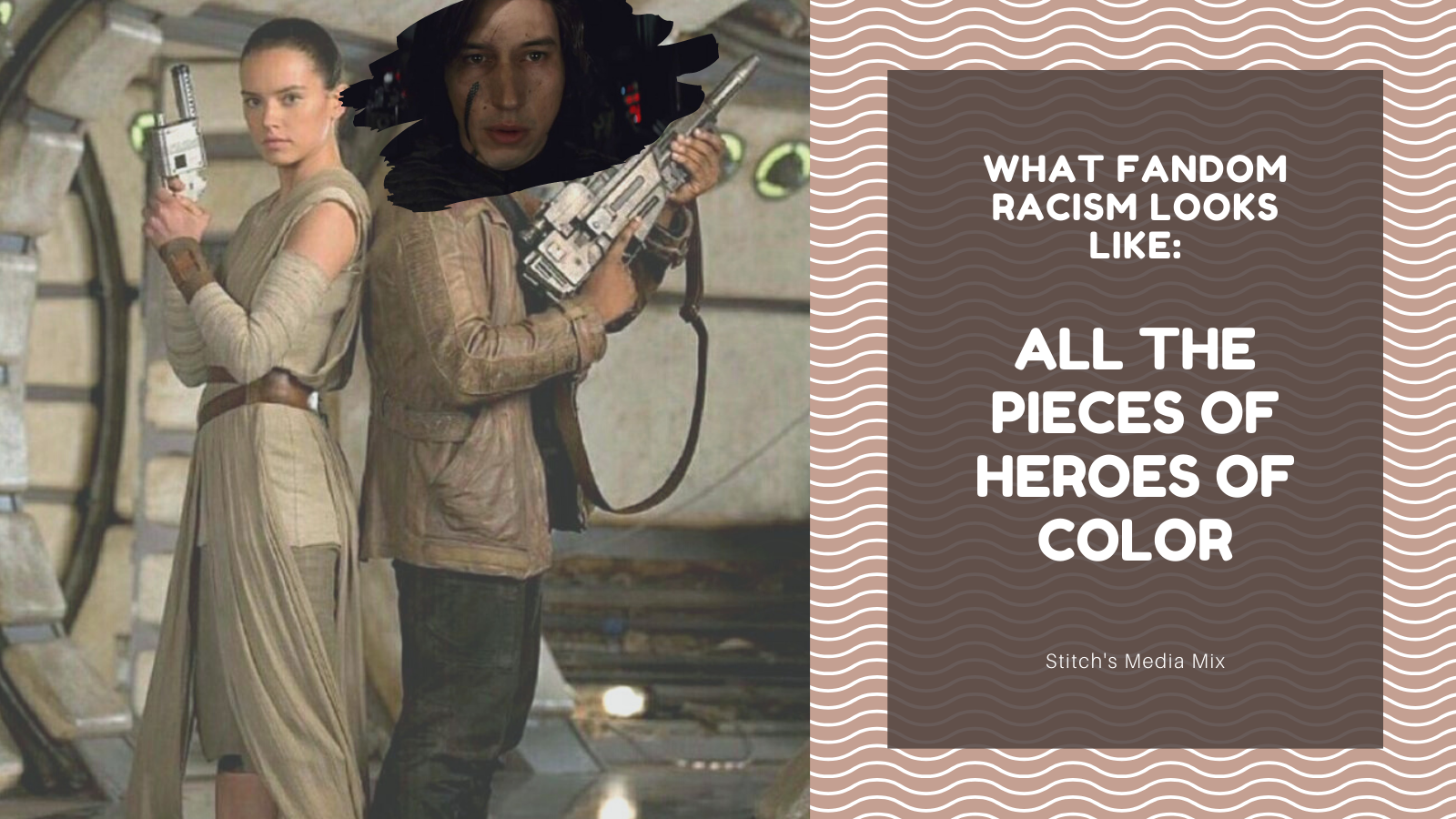
What Fandom Racism Looks Like: All The Pieces of Heroes of Color

“[…] this problem of cannibalizing a hero of color to enhance a white character isn’t new.” – tumblr user thehollowprince in response to a tumblr message received July 16, 2020 (Archive link.)

I’ve never seen folks in fandom cut up aspects of a white hero to then give those characteristics to another white character. No one’s writing stories where Bucky was always Captain America and he went on to link up with the Avengers as a fandom norm. No one’s rewriting the Skywalker saga so that Luke is actually the (totally unrelated) rogue who falls in love with Leia while Han is shot into the icy vacuum of space.

White heroes are never stripped of their backstories, motivations, and the like to boost a minor white character or villain up to heroic status. The things that make heroes like Captain America, Luke Skywalker, or even Batman relatable are never stripped from them and handed to some other white hero. (And yes, that’s two superhero franchises and Star Wars, but I get to do that.)

What I have seen are plenty of instances where a hero of color has the things that make them unique in in their media not just stripped away, but then given to white characters in their show, film or comic franchise.

Read More »

Thor: Ragnarok and Being Grateful for “Taika’s” Loki

So I’m watching Thor: Ragnarok, since I have to do something while I work now that Twitter is currently not an option for me and… I really love this film. It’s fun, it’s weird, and it’s something that does not actually require a lot of effort on my part to engage with. 

Beyond that, however, I was reminded of how ridiculous the hate for this film was from die-hard Loki stans who missed that this was actually some of the best treatment Loki’d gotten since the first Thor film. 

Read More »

Link Lineup – February 2021

Some of the great things I read between last time… and this time! Feel free to pop what you’ve been reading into the comments so I can catch up with your cool thing too – especially if you literally wrote them!


How MF DOOM Saved a Generation of Lost Hip-Hop Fans

DOOM was a worldbuilder, and he was committed to that practice as much as anyone else in music. For me, Mm..Food? was the gateway to an entire universe. His flawless collaborative album with producer Madlib, 2004’s Madvillainy, is an endless array of non sequiturs, multilayered lyrics with hidden meanings, and more of the villain persona, all spat over jazz-inspired production. “Fancy Clown” is the embodiment of the DOOM experience: a narrative about DOOM stealing the girlfriend of a guy named Viktor Vaughn. The catch: He rhymes from Vaughn’s POV. DOOM even released two albums under the alias Viktor Vaughn, a more down-to-earth version of the comic supervillian’s character. (Dr. Doom’s real name was Victor Von Doom.)

This article is just… so good. I didn’t know that much about DOOM before he passed away and my life is poorer for it. DOOM seems to have been the sort of hip hop nerd that I would’ve done well to know as a kid. He was brilliant, skilled, and nerdy on main with a bit that did not quit. I loved this piece so so much because he was someone my older siblings probably grew up listening to and now I do feel like I can understand part of their own journeys through hip hop a bit better.

Read More »

[Stitch Talks Ish] Season 2/Episode 1: Stitch Talks Ish… With Morg

Transcript

[Coming Monday…]

Three Things About The Negative Backlash to Fan Service #2

I have been harassed for writing about racism in fandom spaces since 2017.

Before, people had one off “lol that’s d*mb” and “fandom isn’t racist” responses, but it wasn’t until people started taking me seriously that the harassment amped up to the point where I found myself leaving Tumblr as a result. Sustained direct harassment – insults, impersonations, aggressive pushback, dogpiling, brigading and lying – have marked a large amount of my time in fandom since 2017.

It started with white dude slash shippers when I talked about the laser focus on Hux/Kylo and other white dude slash ships at the direct expense of characters of color in their media. Then Rey/Kylo shippers got in on it when I pointed out how their early Ben Solo characterization was given Finn’s backstory and interactions with Rey. Then people who identify as “proshippers” in and out of the Hannibal fandom and various anime fandoms that I’m also not in got in on the game.

And that’s what it is to them: a game.

Read More »

a letter to the world, a friend, and to everyone else

You probably don’t know me.  What I do for Stitch’s Media Mix, and Stitch, is largely unseen.  I don’t engage in fandom the same way Stitch does— or for that matter the way most of you do— I tend to more actively interact with news and sports than I do with fiction, and I really enjoy avoiding fan spaces. 

But I have known Stitch for over a decade.  I know who they are as a person and who they are as an author, and who they are as a fan.  I know the work Stitch puts in to every article that gets published on here, on Patreon, in Teen Vogue.  And I believe in the work she’s doing.  It’s VITAL that we actively think about, and actively engage in critiquing the entertainment we consume.  If we cannot critique our entertainment, if we cannot place it in the large context of our society (both how it is informed by society and how society informs what we find entertaining) then we are not doing everything we can to make a better society. 

And Stitch has chosen to not just apply critical analysis to fiction and to music, and to the reactions of the fans. She has chosen to take this really incredibly dense academic concept and make it accessible, both in terms of how it’s written (trust me, every single article Stitch writes could be SO MUCH more dense) but also how and where you have access to it.

Read More »

Fan Service #2 @ Teen Vogue: On Fanfiction, Fandom, and Why Criticism Is Healthy

Head on over to Teen Vogue to read my latest Fan Service installment “On Fanfiction, Fandom, and Why Criticism Is Healthy” where I look at the ways that fandom’s instinctive pushback against criticism affects fans in fandom – not just external critics who maybe don’t “get” nuances of fandom cultures.

It’s not censorship or bullying to point out that there are issues in different fandom spaces that require some updated approaches. For example: “Don’t Like, Don’t Read” and “Your Kink Is Not My Kink” are phrases used in fandom to let people know that they should take care of themselves by not reading content they find objectionable based on a matter of different taste. But neither of those phrases are good responses when fans come up against bigotry in fanworks. Telling someone to “just ignore” transmisogyny, ableism, or open antiblackness in fanfiction isn’t just unhelpful; it’s unkind.

I love critique as a mode of expression and meta fandom works are among my favorite outside of well… literally anything to do with Omegaverse. February’s first column was born out of a deep desire to get people thinking critically about why fandom isn’t down with criticism even from people inside of it. Not every critique of fandom is in bad faith or an attempt at censorship/controlling the average fan and assuming they all are – especially when marginalized people are talking about things in fandom that harm us on purpose or accidentally – isn’t a good way to go about things.

Anyway, please go check out the latest installment of Fan Service and feel free to share the piece with interested friends and fans!

On Fanfiction, Fandom, and Why Criticism Is Healthy

😀

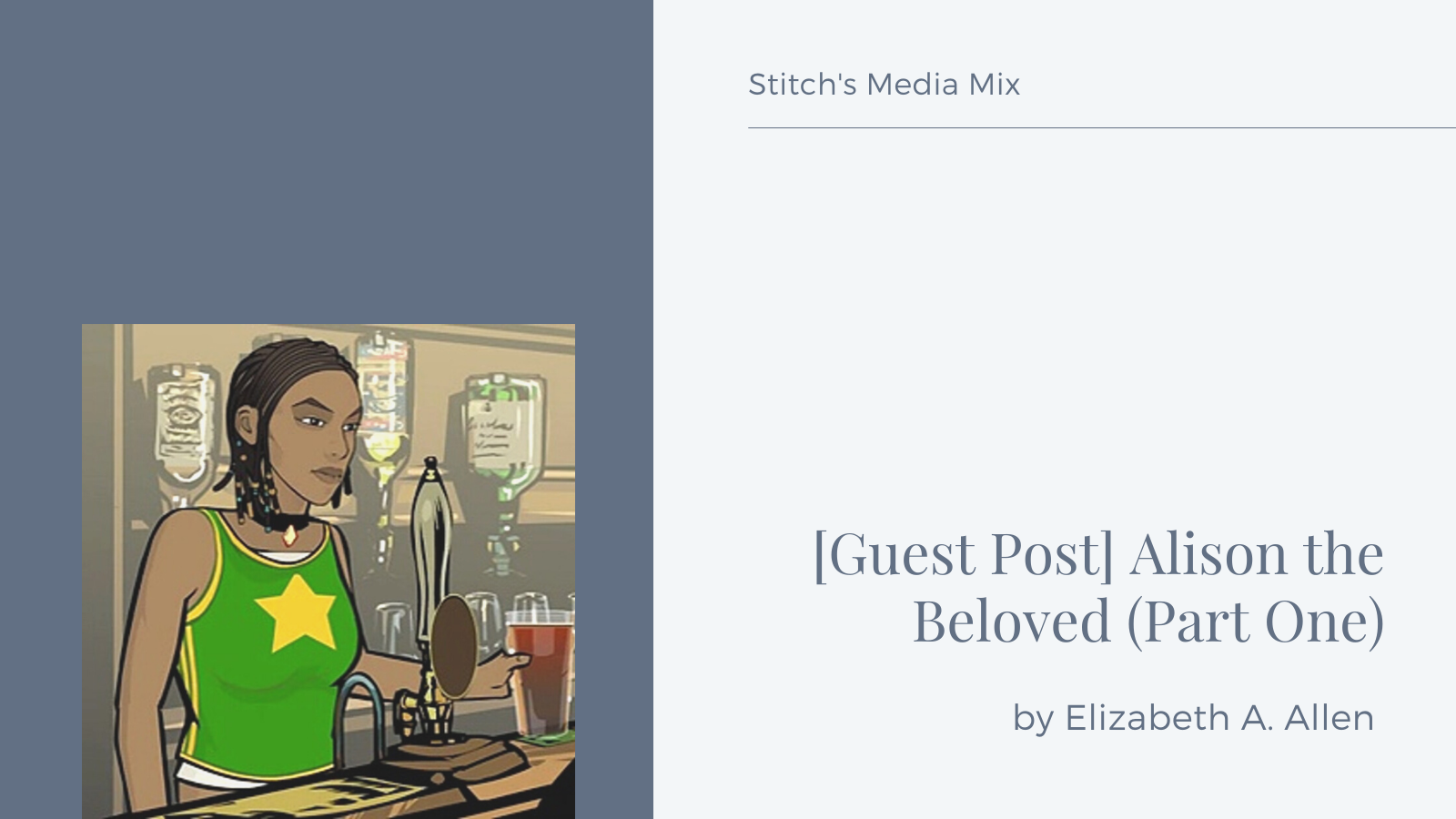
[Guest Post] Alison the Beloved (Part One)

The Black companions in the rebooted iteration of Doctor Who have it rough, especially the women. 

Think of Martha, who suffers Simm Master’s mockery and his enforced servitude of her family in Season 3’s Sound of Drums. Think of Bill, who endures a decade of medical abuse and slow Cyber conversion (i.e., being made into a cyborg) at the hands of Razor Master in Season 10’s World Enough and Time/The Doctor Falls. Think of Grace, who dies of electrocution and fall after defending the Thirteenth Doctor from a gathering coil in Season 11’s Woman Who Fell to Earth. The New Who’s Black companions are generally treated as more disposable and less important than the white characters.

But what if it didn’t have to be that way? What if New Who’s first companion had been a young Black woman — cherished, celebrated, integral to the narrative? How might the experiences of Black companions be different if Alison Cheney had been the first?

Read More »

Introducing… Fan Service @ Teen Vogue

In exciting news… I now have an ongoing column in Teen Vogue on fandom!

Here’s the blurb for Fan Service that’s front and center in the first installment “Who Actually Gets to “Escape” Into Fandom?

Fan Service is a column by pop culture and fandom writer Stitch that looks at the highs and lows of fandom, and unpacks how what we do online, and for fun, connects back to the way we think about the offline world.

This first installment looks at how while fandom was a source of escapism for many people from the endless horrors of 2020, there was one glaring way that escapism fell short or excluded people… racism. How can fans of color expect to escape racism in fandom when racists… are here too?

Head on over to Teen Vogue (TEEN VOGUE!) to learn more about how fandom dropped the ball and how we can be better together in these spaces!

And if you liked what you read there and want more, every other week, we’ll do a deep dive into something critical OR celebratory of fandom, highlighting high and low points that even people in fandom tend to miss when they’re not looking for it.

I’m looking forward to fandom-ing with y’all!

What Fandom Racism Looks Like: “You’re Silencing Meeeee (Feat. Determined Derailers)”

Back in August, I tweeted (as part of a thread) how:

A recurring “fandom vs Me” thing is “Stitch is silencing us” and like… How? How on Earth am I silencing fans of color who are CHOOSING not just to be silent about racism in their fandoms but to support & create horrifying lies about other BIPOC in fandom who are critical?

It’s a recurring theme that I am somehow silencing other BIPOC fans by… having and using my own website, twitter account, and the rare external platforms I’ve been offered across the past six years.

I am silencing others, you see, by having work out in public that people read and share because it is accurate and speaks to experiences that they have had or witnessed in their fandoms. I am silencing BIPOC in fandom, you see, just by existing and talking about what I experience and witness in fandom in a relatable way.

My, how powerful must that make me –

Read More »

Link Lineup – January 2021

Friends it’s the first Link Lineup of 2021! Exciting! There’s so much going on and all of it is cool so let me share what’s been on my mind since the start of this stressful new year!


How “let people enjoy things” became a fight against criticism

Critics have been around for as long as we’ve had artists, and they’ve been the objects of disdain for just as long. Which makes sense, because no one enjoys getting criticized, and no one enjoys having someone tell them that the thing they love is bad. But it’s hard for me to remember any cultural moment quite like this one, with giant high-profile celebrities shouting down critics every week and fans accusing critics of stopping their fun just by writing reviews.

Has criticism suddenly gotten more harsh than it ever used to be? It doesn’t seem to have: Old-school critics are complaining that criticism has gotten more insipid than it ever was before. “Editors and critics belong to a profession with a duty of skepticism,” Christian Lorentzen wrote at Harpers in April. “Instead, we find a class of journalists drunk on the gush.” And Lorentzen’s complaint in and of itself is an old argument, because with criticism has always come people complaining that it isn’t critical enough.

Judging from the in-fighting among critics, criticism is neither especially meaner or especially nicer right now than it was 10 years ago. It’s not criticism that has changed. Instead, it’s the reception to criticism that has changed. And as far as I can tell, that’s because of a major shift in the way we talk about popular things.

I remember seeing a Taylor Swift review get 7 out of 10 in the review (a solid C, a passing grade where I’m from) and trigger waves of harassment towards the reviewer. When Wonder Woman 1984 came out and Black women reviewers talked about how bad the film was, they were harassed endlessly over a movie many of the people freaking out about… hadn’t seen at that point. People treat criticism of fandom – and more specifically, behaviors and bigotry in fandom like uh… racism– as an attack on fandom.

At this point, people hate criticism. They just want to enjoy things, but then they never stop to think that perhaps… critics enjoy crafting criticism. Like I don’t enjoy writing about racism specifically – especially as it’s increasingly racism against me that I get to unpack – but I do enjoy writing and thinking critically. I like looking at a problem and going “okay so this is like this because -“.

And yet, in fandom, everything but criticism falls under the umbrella of “let people like things”? I just think that there’s a difference between pushing back against genuinely poor and too harsh criticism and not wanting anyone to do any criticism because… people enjoy the thing being criticized.

Read More »