K-Pop Fandom Racism Bingo

New to my weird need to make bingo cards for racism I’ve seen in the fandoms I’m in? Check out my Black Panther and Star Wars fandom racism bingo cards!


Unfortunately for everyone who follows me… I’m at it again.

Nothing new has happened in my primary fandoms. I just like making these cards. (Because both the Black Panther and Star Wars bingo cards were born directly from witnessing or experiencing antiblackness, but this has just been on my to-do list for a month or so.)

So here’s my fandom racism bingo card for… various K-pop fandoms. It’s majorly multi purpose so it can be used in reference to almost anything when it comes to racism in these fandom spaces.

Now, here are some helpful explanations/unhelpful snark!

Read More »

What Fandom Racism Looks Like: The Cult(ure) of Nice

In the OTW Election Q&A segment on “AO3 Content Policy and Warnings”, there’s a merged question that asks the candidates:

How will you protect fanworks and meta which are upsetting or offensive across your platforms? What about if those fanworks or meta express views which are illegal/censored in some countries, but perfectly legal in others? Say a fan’s works don’t challenge problematic values endemic to older canons, or espouse problematic values directly. Providing they politely abide by AO3’s TOS, do you believe this fan deserves equal protection under Ao3’s TOS (a posting platform, confidential treatment of their RL identity, ability to report harassment)?

Mind you, this question clearly is more focused on protecting fans creating content that could be considered problematic or harmful than it is on considering that fanworks aren’t more important than fans – and we’ll talk about how this sort of questioning elides conversations of race and racism to make it out to be about kinkshaming and anti-queer rhetoric another time, probably tomorrow.

But what stands out is the last part:

Providing they politely abide by AO3’s TOS, do you believe this fan deserves equal protection under Ao3’s TOS (a posting platform, confidential treatment of their RL identity, ability to report harassment)?

While I’m sure, if pressed, the people responsible for that Frankenstein’s monster of a question will deny that racism and racist fanworks are the kind of content they’re talking about (because they always say “we weren’t talking/thinking about racism in fandom” and uh… duh) –

Let’s work this word problem out with some fandom racism:

Read More »

Fandom Racism 101: Clocking and Closing The Empathy Gap

How does fandom’s empathy gap come into play when the trauma of POC is on the table? Why does the empathy that fans extend to white characters, fans, and performers, hit a hard wall at POC – especially when it comes to Black characters, fans, and performers in my direct experience?

In the Slate.com article “I Don’t Feel Your Pain”, author Jason Silverstein uses the following example as he describes the racial empathy gap:

Let’s do a quick experiment. You watch a needle pierce someone’s skin. Do you feel this person’s pain? Does it matter if the person’s skin is white or black?

For many people, race does matter, even if they don’t know it. They feel more empathy when they see white skin pierced than black. This is known as the racial empathy gap.

The way that non-Black people literally do not believe that Black people feel the same levels of physical pain – documented through over a century of studies – is one way that we see the empathy gap play out. However, this isn’t the way that it tends to play out in fandom because there’s no one out there pricking fans of color with pins to see if we bleed the same color and amount. (Yet.)

But what they do is constantly privilege white feelings over Black ones.

Read More »

[Stitch Talks Ish] Episode 6: When Black Lives Matter, But Black Opinions Don’t

Episode Notes

Transcript

Hello, darlings!

So this is episode – officially, Episode Six-  of Stitch Talks Ish. In the timeline, it’s Episode Seven because we had a bonus episode last month, I believe to celebrate the release of Yoongi’s second mixtape as Agust D, D-2. So, if you haven’t listened to that episode already please go check it out.

So this episode is called when “Black Lives Matter, but Black Opinions Don’t” because I have spent pretty much all of June and part of May realizing that for a lot of people, you know hashtagging, sharing petitions, and donating that is really all They think they have to do to be antiracist whether in fandom, in public, in their day to day lives, whatever.

They do the bare minimum, which is publicly perform antiracism.

They’ve bought the books. they own White Fragility. They share their few friends of colors’ GoFundMe ease and cashapps. They really do care about racism in the abstract.

And of course, they definitely don’t want Black people being killed because we’re Black, but they also don’t really care about us as people.

Read More »

Antiblackness in (Service of) the Archive: A Statement

Huge chunks of transformative fandom are currently playing the most actively antiblack game of telephone in the world.

And I’m the subject.

What will I be by the time they’re done? I’m already being compared to trans exclusionary radical feminists despite being nonbinary, accused of holding grudges against people I don’t know and have likely never interacted with, and being slandered literally every single time that someone else mentions me as an author to read.

And all because I write about racism in fandom in a relatively sharp tone.

Read More »

Fandom Racism 101: Introduction

The first time I used the hashtag #WhatFandomRacismLooksLike, it was March 2018 and the Marvel Cinematic Universe fandom post-Black Panther was hell. Despite everything that Black fans in the fandom had been trying to prepare ourselves for from the fandom, the fandom’s immediate focus was on either the minor white male characters who were in the film on any level or on diminishing the value of Wakanda.

As a result of what I kept seeing, I decided to write articles about what racism looks like in fanworks as well as in the behavior on display by fans towards performers and fans of color alike. I’d been doing it on Tumblr from 2012 and on my website since 2015, and I figured that as someone seeing all of this nonsense happening right in front of my salad, that I should just keep at it.

Read More »

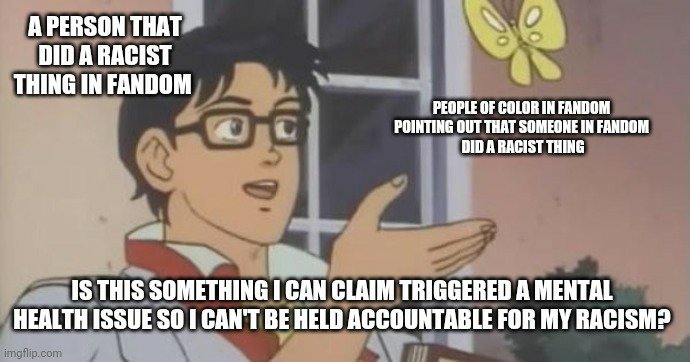
Making Memes To Cope With Fandom Racism

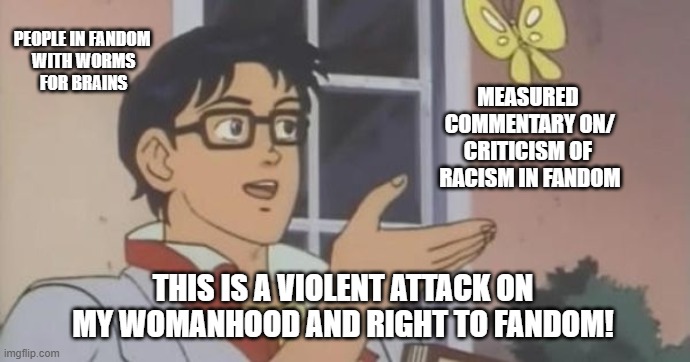
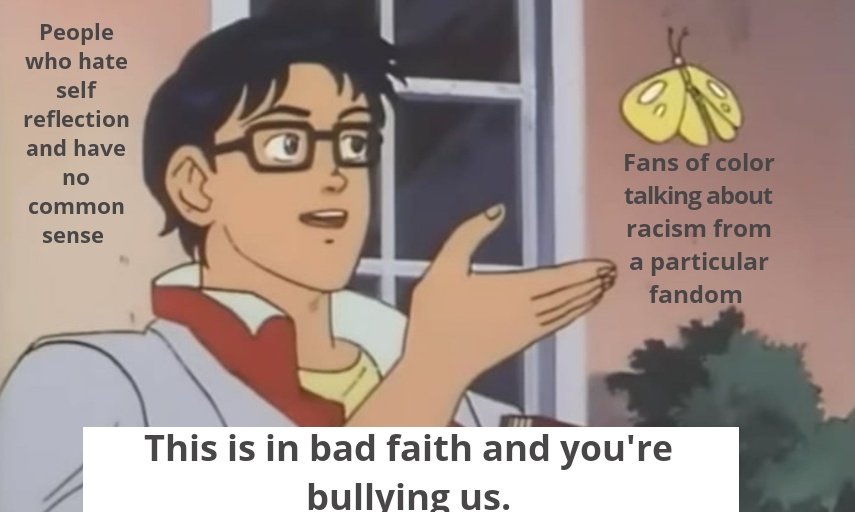
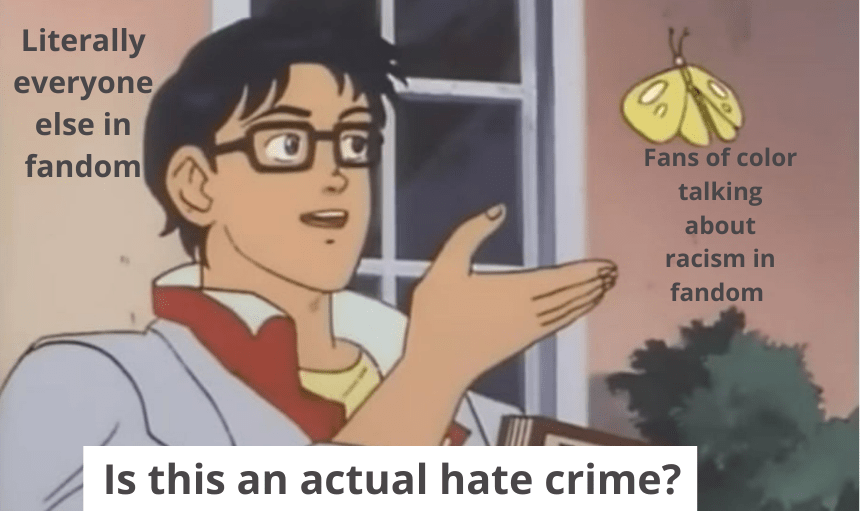
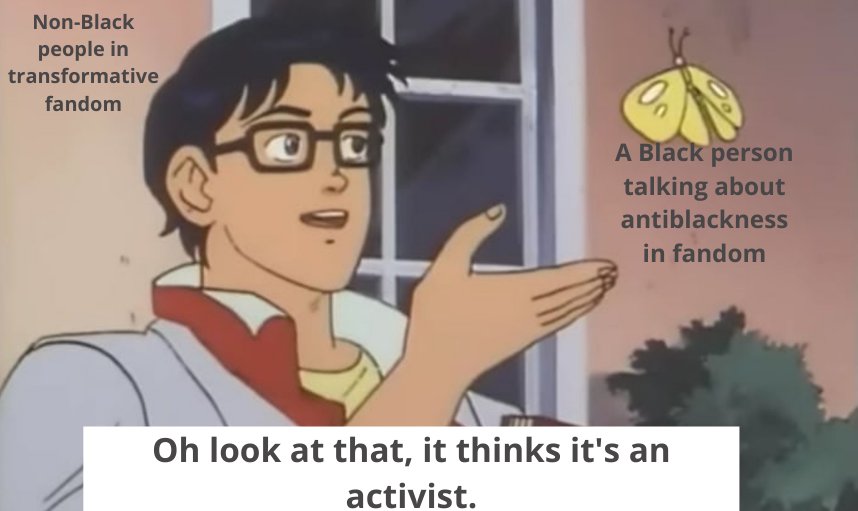
My latest thing has been to absolutely overuse the “Is this a pigeon” meme format.

I literally cannot stop making memes in this format.

Mostly about how ridiculously racist transformative fandom insists on being.

They’re a surprisingly effective coping mechanism for me as I try to figure out how to come to terms with the fact that transformative fandom is not getting better. I have a worse reputation for talking about antiblackness in fandom than anyone who’s actually been antiblack in fandom does for being antiblack.

That’s definitely a hard pill to swallow.

So I’ve been making memes to cope.

Variations on the same one mostly because it’s hilarious, but I’m always looking for new memes to mess with.

Since they’re mostly on tumblr and y’all mostly aren’t there… have my coping memes:

How do y’all cope with the sad fact that transformative fandom is pretty much Like This all the time?

What Fandom Racism Looks Like: For Clout and Social Capital

Across Korean pop/hip-hop twitter, anyone who calls out or even mentions the antiblackness that is a constant from the artists, the industry they’re part of, and the fandom spaces we’re in on and offline… gets accused of doing it for “clout”. 

And by clout, they mean positive power or influence in fandom

Here’s a newsflash for y’all: there’s literally no scenario or fandom where a person of color – or even a white person – talking sharply and critical about the racism in a fandom, in the source material, or from a celebrity gains measurable powerful and positive influence in fandom for it. 

None. 

I have had this site for five years and was on Tumblr talking about racism in fandom for three or so years before that and if you think any of that translated into people overwhelmingly and actually listening to me when I talk about racism in fandom…

You would be extremely wrong. 

Read More »

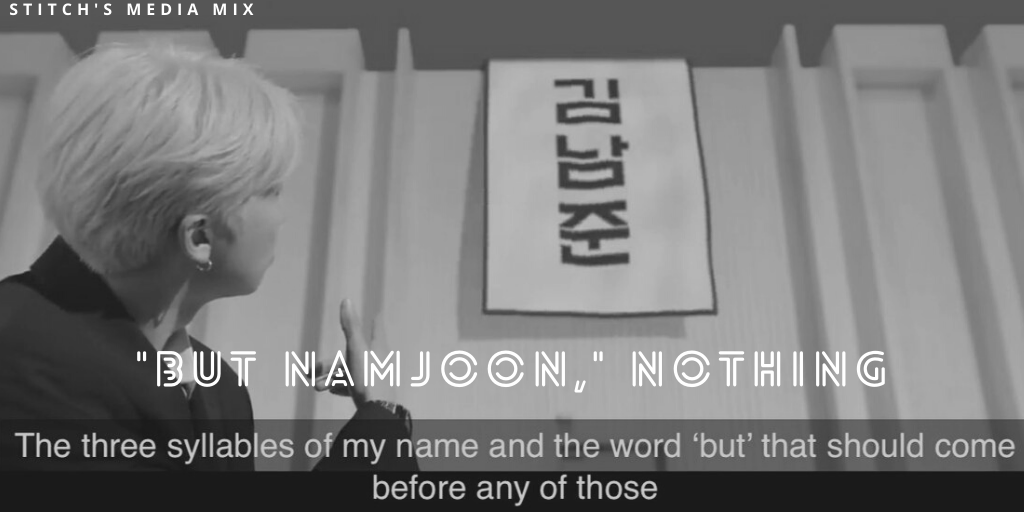
“But Namjoon,” Nothing – Antiblackness in the K-pop Industry and its Fandom Spaces

Have you checked out the rest of the works in this year-long project yet?


The first time I think I saw a “But Namjoon” in the wild was almost a year ago when Stray Kids’ Bang Chan came under fire for the attempted cornrows in his hair back in mid-April 2019.

During that time, fans of the group would respond to any person with a BTS-related icon that commented on that particular instance of cultural appropriation with comments dismissing their comments because “Don’t you stan BTS”.

Many of the comments were like “But Namjoon [had attempted an afro, had whatever this style is supposed to be, covered that one Shinhwa song, etc] so how can you be critical of anyone else if you like him”.

If this was strictly an attempt at calling out hypocrisy that acknowledged that our faves in this industry are all (largely) similarly problematic when it comes to respecting Black culture(s), maybe I could’ve gotten it. Maybe I could’ve even managed to gloss over it.

But this is not a fandom where that sort of thing happens – most fandoms aren’t.

Read More »

Anti What, Exactly?

“What is the opposite of fandom? Disinterest. Dislike. Disgust. Hate. Anti-fandom.”

Melilssa A. Click. Anti-Fandom: Dislike and Hate in the Digital Age 

The anti-fandom(s) – and anti-fan(s) – of 2020 look far different from what Jonathan Gray put together in 2003’s “New Audiences, New Textualities” when he described anti-fans as, “those who strongly dislike a given text or genre, considering it inane, stupid, morally bankrupt and/or aesthetic drivel,” (70).

The internet and fandom as we know it have both changed drastically in the past decade and change since he first attempted to provide that definition – a definition that Gray himself has tried to expand upon and contextualize across the years, culminating in his essay in Melissa A. Click’s collection on anti-fandom referenced in the introductory quote.

At this point, if you’re in transformative fandom, you’re probably faintly aware of the term “anti” and the variety of ways it’s used to describe other people in fandom who seem to be against fandom in some way that is rarely fully explained.

In part because most of the people explaining it… can’t explain it very well because they have wildly varying definitions of what an anti is and what anti behavior looks like.

At this point in fandom and fandom discourse, what is most “anti”/opposite/against fandom is not letting fans do what they want without any criticism whatsoever. Which includes, as I’ve noted across the years… fans creating purposefully or incidentally racist fanworks.

I mean, really… considering that when John Boyega was getting shat on by Rey/Kylo fans – members of a fanbase that’d been harassing him and shitting on him publicly for his entire time in the Star Wars sequel trilogy – I saw tweets accusing him of “siding with fandom antis” –

It becomes clear that in many fandom spacesm, the term “anti” at this point is mostly meaningless.

(And that Black people who aren’t doing what fandom wants will always be viewed and (mis) treated as outside of or against (anti) fandom.)

Read More »

What Fandom Racism Looks Like: Migratory Slash Fandom’s Focus

Note: The section on RPF and whtiewashing deals pretty plainly with real person fan fiction – where a real celebrity is treated like a character in fan works – but from the POV of “stop whitewashing them” rather than a judgement call on the fandom itself. I’d suggest skipping this section, scrolling down to the solutions section of the piece, and waiting a little bit for me to finish writing my actual RPF-focused installment of What Fandom Racism Looks Like later this year because it’s been in the works for a while and will tackle K-Pop RPF, Hockey fandom, and the One Direction fandom’s endless racism towards Zayn. 


The Fanlore page for Migratory fandom describes it as, “the most recent term used to describe the idea that slash fans are always on the lookout for the next shiny, new juggernaut pairing”.

First seen in fandom discussions across Fail_Fandomanon – one of many multi-fandom anonymous memes – the term is a reference to this idea that slash fans are constantly moving to the next fandom that’ll provide them their dose of slashy goodness. 

On the surface, there’s nothing even remotely wrong with moving to another fandom because the one you’re in is running dry on content. Honestly, I’m right there with folks because when a fandom I’m in is dried up entirely or the fan content it’s creating has been done to death before… I always feel like jumping ship at least for a little while.

So I get the motivation.

But this is “What Fandom Racism Looks Like” and you know that means that there is something I find frustrating about migratory slash fandom that falls under this series….

Read More »

Whose Job Is It To Fix Fandom?

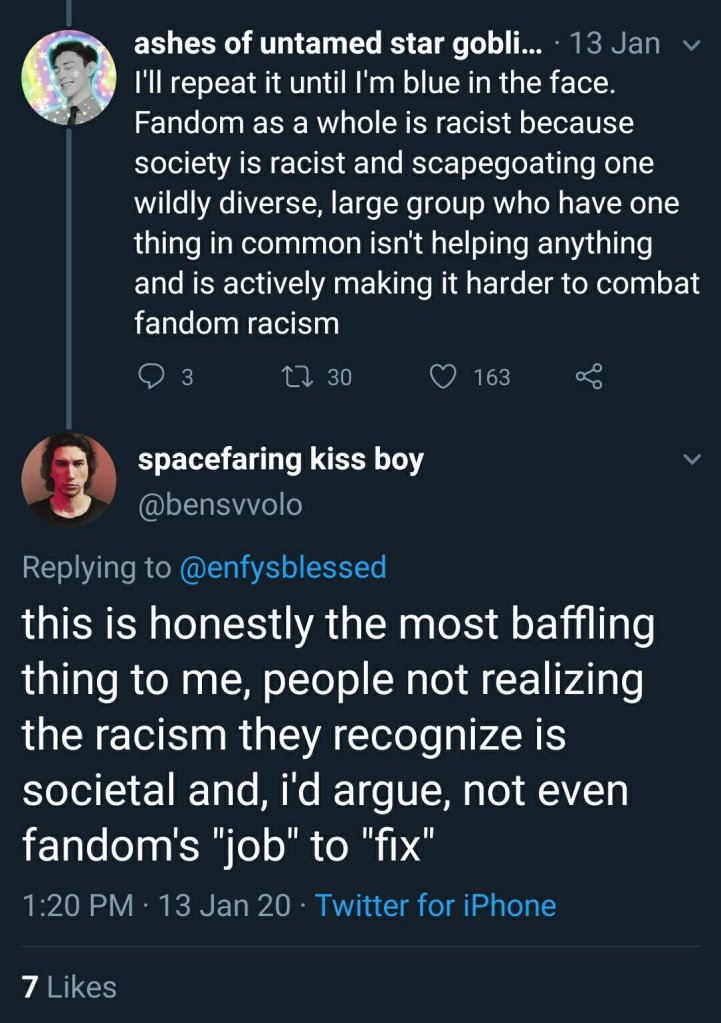
During the first two weeks of January, I came across an exchange between two Star Wars fans who were absolutely holding on to the narrative that the Rey/Kylo shipping fandom was being burdened with false accusations of racism – two weeks into the fandom as a whole going off on John Boyega over separate comments he made on New Year’s Eve.

@enfysblessed – I’ll repeat it until I’m blue in the face. Fandom as a whole is racist because society is racist and scapegoating one wildly diverse, large group who have one thing in common isn’t helping anything and is actively making it harder to combat fandom racism

@bensvvolo – this is honestly the most baffling thing to me, people not realizing the racism they recognize is societal and, I’d argue, not even fandom’s “job” to “fix”.

Two things stand out to me about these two tweets.

First, there’s the idea that supposedly scapegoating a “wildly diverse, large group” (Rey/Kylo shippers) for racism they are either participating in or not stopping from their fandom… is “actively making it harder to combat fandom racism”.

As someone who’s been writing about fandom racism relatively professionally since 2015? (And casually, to an extent, since the time of the Sleepy Hollow and MCU fandoms’ initial antiblackness?)

It’s actually fans like those two that make it hard for me to have my work taken seriously and for other fans to recognize and work against fandom racism.

Read More »

Fuck Your Fake Woke

This is essentially a prototype – originally posted on Patreon ages ago – of WFRLL: Woke Points For What. It’s definitely a bit… spicier than that article. I fixed some spelling errors and comma placement but for the most part, this is the article posted on Patreon… whenever I posted it on Patreon.


Right about now, in fandom spaces, “fake woke” has all but replaced the GamerGator popularized “virtue signaling” when people want to get mad about the fact that some of us care about the delicate challenge posed by trying to get positive representation for marginalized people in fandom and media. 

The second that I see someone call someone else “fake woke” or accuse them of being interested in talking about or unpacking social justice in order to get some sort of social credit – via “woke points” (courtesy of the Reylo fandom who keeps using that specific phrase to discredit anyone that’s even vaguely critical of their ship) or “virtue signaling” or even the good ole fashioned “ally cookie” – I know to be wary. 

Read More »

[Stitch Answers Feedback] Do You Know What True Antiblackness is?

I get a lot of weird ass messages and mentions, but this message, sent on the first day of Black History Month 2020, definitely ranks at the top of the weird ones.

In case you’ve missed it, January was a month full of Star Wars fandom criticism:

All of these were written/created in response to a fairly large amount of Rey/Kylo shippers showing up and showing their racist little asses over John Boyega’s initial “lay the pipe” comment (a single sex joke) and then over him dunking on their ship.

But it’s not actually about my feelings about the ship. Actually, the one thing I tried not to do was talk about my feelings about the ship because that’s not what any of this is about.

It’s bigger than ships. It’s about how this fandom has been antiblack on main for years and is finally throwing off the hood to show its real face.

Read More »