I had a great time talking with Maggie and V over at imetyouonlj, a really cool fandom podcast that’s just tons of fun! Please go check it out!
(Pretty much they’re everywhere you get your podcasts!)
Have fun and happy listening!
I had a great time talking with Maggie and V over at imetyouonlj, a really cool fandom podcast that’s just tons of fun! Please go check it out!
(Pretty much they’re everywhere you get your podcasts!)
Have fun and happy listening!
Fans can react in concerning ways when their celebrity favorites screw up or misspeak in ways that hurt fans. It’s as if the attachment to a particular celebrity unlocks a desire to do whatever possible to maintain that celeb’s power and positive press. Even if the celebrity has been accused of actual crimes, even if we have proof of them doing something inexcusable, their stans will rally in order to protect them from criticism and accountability.
Enter: Nicki Minaj and the hold she has on her fans, known as Barbz. Not only do a subset of fans feel personal responsibility to promote her, but she herself has actively mobilized them over the years against people that she is in conflict with, on scales both large and small.
On Nicki Minaj, the Barbz, and When Stans Prepare for Battle
Once again, I forgot to post this when it went up uh… two weeks ago.
Nicki Minaj is just… a really good example of what happens when celebs actively make the choice to hurt people. She has millions of dollars, a fanbase that loves her, and some level of talent. And what has she spent a lot of 2021 doing? Antagonizing critics, harassing the woman her husband harmed when she was a teenager, and beefing publicly with other celebrities and even just random social media users. Like what got into Nicki’s head to make her think defending former Little Mix member Jesy Nelson’s blackfishing and attacking actual Black woman Leigh Anne Pinnock for calling it out was in any way necessary?
If I ever reach some sort of financial success and you see me out here fighting with people on social media – especially if I’m dead wrong – understand that something has gone horribly wrong.

Jeanne and I catch up and compare notes about the rest of Loki, how our expectations were met, exceeded, or underwhelmed , and the current state of fandom discourse (which has managed to shift so hard in just a matter of months).
There’s no such thing as an “unproblematic fave.” People — and the things that we create — are informed by the world around us, and we can be exposed to some pretty problematic environments that are hard to move away from. And if people, especially ones we admire, are going to continue making both positive and negative choices, then what actually matters in fandom isn’t finding some mythical angel celebrity who never does anything wrong. Rather, it’s unpacking our own responses. What do we do with the realization that someone responsible for our fandom happiness in some capacity has been careless, or made a mistake, or been intentionally cruel or predatory?
What Do You Do When Your Fave Screws Up?
A) I forgot to link to this article last week when it went up! My bad! Things have been very busy!
B) As with the majority of my work, this pulls from experiences I’ve had within fandom and how I had to fight off the knee-jerk response to go “no that person couldn’t have done that”. I mention it in the piece (and have mentioned it elsewhere, I’m sure) but I used to be a huge BIGBANG fan. My bias wrecker was the rapper TOP. My bias… was Seungri. My nieces and I listened to his solo stuff regularly and we thought he seemed cool… until I started seeing threads on Twitter about the Burning Sun nightclub scandal and the extent that he was… very much not cool.
Instantly, I cut him off. I took the BIGBANG songs out of my playlists, deleted his solo songs from my phone, and resolved to never say a nice thing about him again – a thing made that much easier by the knowledge of the things he’s rumored and confirmed to have done. We don’t speak his name in our house and he’s basically dead to us.
But that sort of merciless pruning isn’t the norm. We link so much of ourselves to the celebrities that we love that sometimes, when our favorite public figures are accused of something minor to majorly awful, we look for reasons to keep on moving. We look for excuses to explain away the minor-to-major bad thing our person did. Sometimes, as seen in multiple fandoms and especially in the case of Seungri and his still-active fanbase, we hurt others over the situation rather than acknowledging the harm done by this public figure.
But we don’t have to. We can see when our favorites do bad things – whatever they are – and decide on our own how we’re going to handle it without defending them or hurting someone else in their name.

Content Notes: descriptions of police brutality and violence from law enforcement that includes sexual violence and violence against vulnerable people like children. Screenshots that mention harassment that include racism, threats, harassers urging people to self harm, and doxxing.
I also swear a lot and in a way that can be read as “at” the people who pull the nonsense I’m talking about.

Genuinely, I can hardly think of a clearer example of what fandom brain rot does to a person than the repeated insistence across multiple fandoms that ACAB – “All Cops Are Bastards” – somehow includes people on the internet who are critical of fandom at any level including just… being critical of racism in fandom and media in public.
The thing is that yes, ACAB as a term existed well before the horrific events of Summer 2020, the time period when lots of people on your social media feeds decided to put the acronym in their bios and display names for the first time… But it has never revolved around anything other than rejecting the violence that law enforcement/policing does as a system.
As Victoria Gagliardo-Silver wrote in her op-ed “What I mean when I say I want to abolish the police“:
Something is very, very wrong in American police culture. This is why the saying “ACAB” — or “All cops are b*ds” — has become a popular rallying cry. It doesn’t actually mean every single cop is a bad cop, just like saying Black Lives Matter doesn’t mean white lives don’t. “ACAB” means every single police officer is complicit in a system that actively devalues the lives of people of color. Bad cops are encouraged in their harm by the silence of the ones who see themselves as “good.”
Holding one police officer accountable every time a black person is killed by police is not enough. The issue isn’t “a few bad apples”; it’s a tree that is rotting from the inside out, spreading its poison.
ACAB serves as a punchy shorthand referring to the way that there can’t be such a thing as “good cops” in a field fueled by violence including fatal antiblackness, sexual violence, theft, bigotry beyond all of that, and just… an entitlement to other people’s lives in literal cases.
I understand that with this somewhat valid fear of random people harassing others over fandom – a thing that happens no matter what you’re into – it is tempting to not just accuse people of policing your fandom experience… but to compare them to the real police.
“Fandom police” as a term has been around for ages too… but it’s the way it’s being used now to refer to fans as actual cops that’s literally the problem.
Read More »
In this “Bonus” Episode, I talk about… how Steven Hassan’s BITE model of fandom can be applied in multiple fandom contexts because fandom is a space that’s kinda… rife for cults of personality, manipulation, etc at EVERY level. But also that there’s a difference between “culty” and “a cult” and people do need to get that too.
Unfortunately I still can’t AFFORD to get transcripts done but one day… ONE DAY.
I hate this thing people across fandom do where they need people to:
And if you don’t do the things they demand of you (for some reason… but you do not know these people and they do not know you or anything about you), they will then never listen to you about what you’re actually saying… because you are bad and wrong for not listening to them about this thing.
So they won’t listen to you talk about racism in fandom. They won’t listen to you when you say that no one should be harassed in or because of fandom. They won’t accept that you can think that and also want people to understand that bigotry doesn’t belong in fandom.
Read More »Near the end of June, I made the mistake of commenting on Star Wars fandom stuff when I saw screenshots of some members of that subfandom gloating about John Boyega briefly losing his blue check/verified status on Twitter as well as kind of assuming the worst about his exit from Rebel Ridge – especially once people started kind of claiming that he was “difficult“. (Like fully going “perhaps he will have his MeToo moment and people will know that he’s truly garbage… like we have all along” in some tweets I glimpsed.)
Aside from the comment calling me a bootlicker of color (for making a thread about fandom nonsense from their camp and not immediately writing a Teen Vogue article about John Boyega, who I have no access to and still cannot reach for clarification or an interview), one comment that stood out to me called me a coward because I didn’t like… leap into the way of actual non-fandom white supremacists in defense of Rey/Kylo fandom. Again, a fandom full of people that hate me for pointing out their co-fans’ racism.
Read More »It was such a delight to host the Q&A for this event and I loved speaking with Fern, IR, and Lilah about their amazing pilot for Heart to Heart and what the future for the shorts will (hopefully) bring.
Heart to Heart is genuinely one of the funniest things I’ve seen in my entire life and it’s made with love from people who truly get what it means to want to be seen. It’s incredibly charming, super witty, and has probably my favorite trope outside of Accidental Baby Acquisition.
I also, aside from one brief (and hopefully edited out moment) where I forgot my mic was muted, leveled up as a person who hosts things! Which is exciting! Let me host more things and interview more cool people please!
Head on over to Eventbrite to register for the FREE event for the weekend of August 20th!!
And of course, share widely! It’s a great pilot and David Tennant is used to FULL fantastic effect here. Everyone needs to check Heart to Heart out and then hype it up so we can get MORE OF IT!!
Fandom has changed a lot since I was a kid. As a tween, I had no hope of getting in touch with celebrities I adored like Britney Spears and Whitney Houston. Now, I’ve not only spoken with some of my celebrity favorites on social media, but I’ve even fought with a few.
The technology of fandom is changing, too. Parasocial relationships — a largely one-sided relationship between a fan and a public figure they feel close to due to social media — are everywhere online. And the companies behind some of the biggest acts in K-pop are pioneering a new way to monetize them. They’ve developed online platforms to help K-pop fans feel as though they have direct access to their idol favorites. That access helps shape the way these fans interact with the idol as a form of friendship and how they engage with other fans
K-POP’S FANDOM PLATFORMS ARE CHANGING WHAT IT MEANS TO BE AN IDOL
I’m always online. Obviously. I spend a lot of time – too much time? – on Twitter, but I also do a lot of fandoming across different apps for Korean idols. Hell, at one point I actually lowkey lived on streaming app V Live because the phone I had at the time had notifications that worked so when one of “my” favorites would go online, so would I. I was awake so dang early back then. These days, I may sleep through my notifications, but I stay active on the different apps for my faves. I don’t use LYSN or bubble but I have been on Universe for Monsta X and Brave Girls (especially my bias Minyoung).
And of course, I’m on Weverse. Most of my favorites (and one former favorite… Gfriend) are on the Weverse app and I use the app to communicate with other fans and moon over idols. It’s more “personal” and private than just trying to communicate with an idol or other fans on Twitter and so, for the most part, it feels safe to engage.
I loved talking with Areum Jeong and Nicole Santero (who runs the @ResearchBTS Twitter account) because they’ve got insight for days! I also am grateful to Maxim and Leigh, two fans who graciously provided their thoughts about the apps they use to engage with their faves. So many wonderful fans provided their insight and I only wish I could’ve used it all in the final piece!

This episode obviously has spoilers for the first episode of Marvel and Disney+’s Loki. We also speculate about the future of the show and its arcs/plots in a way that may prove to become spoilers if we’re as accurate as we want to be. Additionally, we talk candidly and cheerfully about villains, what they do, and why we connect with them (in the specific and general sense). While we don’t talk about anything in specifics – I feel – we do brush over cannibalism, The Authority’s fascism, and all the dreadful things in the plot of the 1999 film Titus. We also talk about our experiences in fandom over the years. Use your own best judgment, babes.
Read More »Fandom is incredibly queer. Its origins as a space for LGBTQ+ people are well-documented, and we see that today, too. Fandom is often an online-offline queer community, supporting fans who may or may not see themselves in actual source material, but who can gather together and feel seen by each other.
This month, we’re celebrating Pride by talking about queer histories and communities within different, largely English-language, fandoms and how these spaces have allowed us to be ourselves on main in a major way.
The first of June’s two Fan Service columns is a celebration of queer fandom. If you have somehow missed it before: I am queer.
What that means is always complex to explain because queerness is hard to define and I love being indefinable. But I’ve been here and queer for a hot minute and fandom is one of the things that helped me understand and express what I was experiencing. (It’s also where I got my first girlfriend about a decade ago! Shout out to M, who deserves The World Forever, and who first liked my Batman fic and then really liked me!)
I wanted to write this piece to celebrate one of the best things about online fandoms: that this is a great space for queer fans to figure out who we are and to build communities/relationship. Even if you don’t actually use that label for yourself – I do, obviously, but you can mentally replace it with something else that works better for you – you’re still part of something amazing and I wanted you all to know that you are loved. We’re moving along the path paved by an incredible legacy of older queer fans that I am proud to claim and be a part of. I’m truly happy that I can be in these fandom spaces with y’all.
Happy Pride, Pumpkins!
When I began the research for Last Night at the Telegraph Club in earnest, I knew that I needed to know more about those lesbians of color. More specifically, I needed to know what it was like to be a Chinese American lesbian in San Francisco in the 1950s, but they were nearly invisible in the historical record. The few times I came across references to Asian American lesbians, they were mentioned in passing or relegated to the footnotes.
It was enough to make one think that queer Asian Americans didn’t exist back then, but I knew that wasn’t true. What has happened is that our experiences have been erased or marginalized, deemed less important than the experiences of white LGBTQ people.
If you’re like me and you like learning more about queer histories of color, please check out this piece and get hyped for some awesome histories that you probably didn’t know before!
Read More »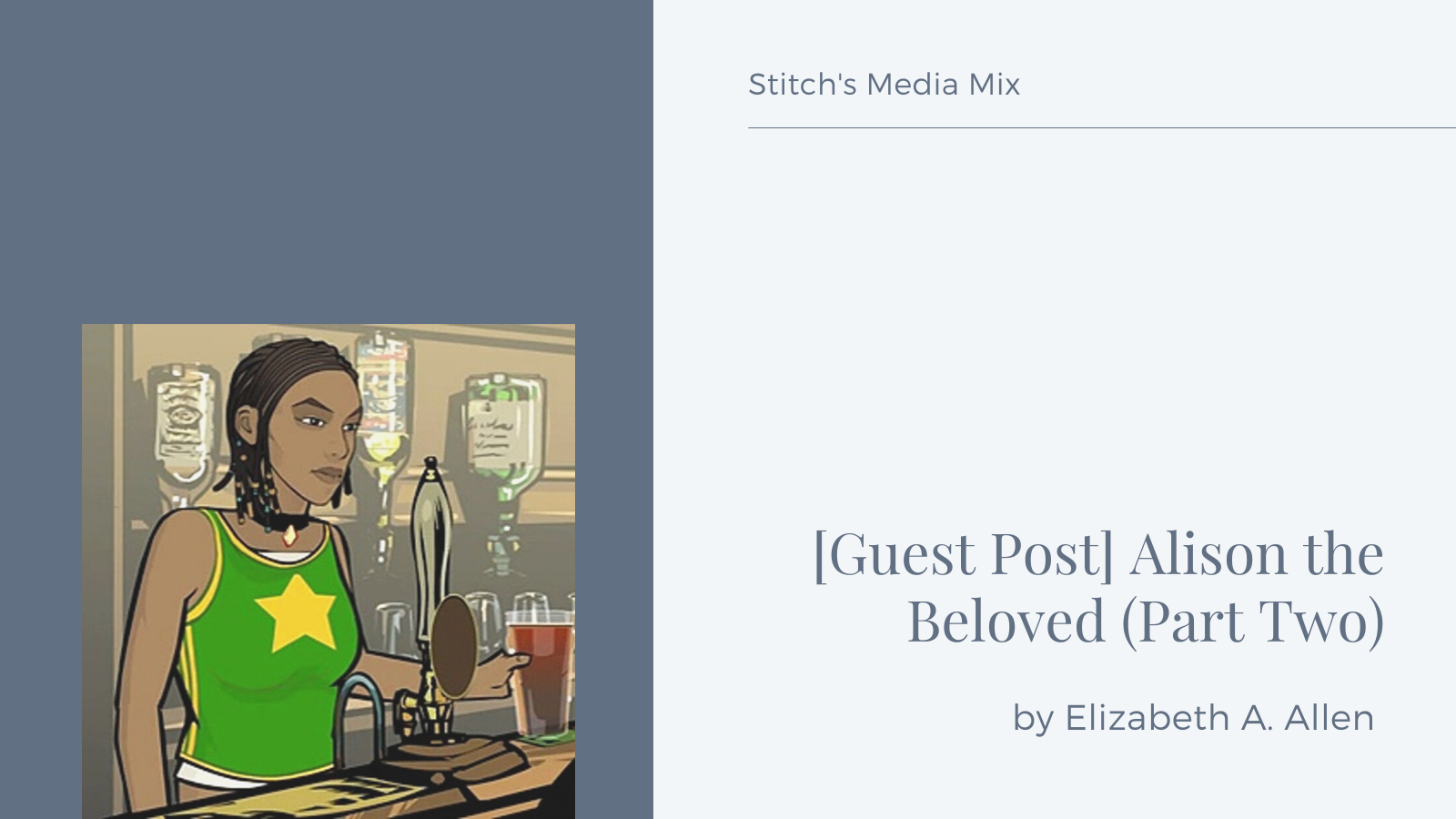
In the first part of this essay, I explored the portrayal of Black women in Doctor Who, using the example of Alison Cheney. She appears in Scream of the Shalka, a 2003 web animation. Preceding the 2005 TV reboot by two years, she is the first broadcast non-white companion.
I wrote about Alison’s role as the Doctor’s beloved, a status unusual for Black characters, and how she could have challenged the New Who’s portrayal of Black women as largely disposable victims. At the same time, SotS’ refusal to give Alison the lived experience specific to a Black London woman in an all-white small town reduces her revolutionary potential.
Alison’s ability to change the Whoniverse is also limited by SotS’ — and Alison’s — unpopularity. In this part of my essay, I dig into fan characterizations of Alison, using the AO3 corpus as a representative sample. An examination of SotS fan content on AO3 reveals that Alison may be the Doctor’s beloved in SotS, but she’s largely unloved in fandom.
Read More »I found my own Trinidadian upbringing confusing. On one hand, I was made to believe that race mattered very little, echoing sentiments of postraciality that surfaced after President Barack Obama was elected. My schoolbooks emphasized that Trinidad and Tobago was a rainbow utopia, evident by the shoehorning of as many creeds and races as could possibly fit into small, grayscale pictorial representations. I’d look at my face in the mirror—my light but definitely brown skin, my broad nose—clocking my features against the fact that my last name was confusingly Chinese (my great-grandfather on my dad’s side came from there) and wondering what the hell I was.
In the Caribbean, there are so many complex relationships with our Blackness, what Blackness could look like and who got to be Black in the first dang place. In islands like Trinidad where you have a more visible history of non-Black people of color (primarily Indian and Chinese) marrying and loving Black people, Blackness is complicated. And so is your understanding of where white supremacy fits in to the conversation. Because the people in power in Trinidad, in the Virgin Islands, in Jamaica… aren’t actually or typically white people. And yet, white supremacy thrives in these places to the point of harming people of color who live there.
Read More » Stitch's Media Mix

You must be logged in to post a comment.