What Fandom Racism Looks Like: Revisiting “POC Coded” White Villains/Anti-Heroes

Recently, Shafira Jordan’s sharp and insightful article “How White Fandom is Colonizing “Character-Coding”” has been making the rounds around fanwork creating & consuming social media. It’s a piece that speaks to something that I also have talked about (a few years ago): the way that white fandom will code white male characters as POC while also hating the hell out of characters of color in the source media/dismissing them entirely. 

This ranges from deciding that a character oppressed racially in-universe like Loki being Jotun was directly paralleling an experience/existence of color to claiming they are “actually” of a marginalized identity like Kylo being Space Jewish because the actors playing Han and Leia are.

Read More »
[Thread Collection] Revisionist Fandom History 2021

Still locked on main because being random racists’ hyperfocus remains distressing as hell, but if you’re already who already follows that Twitter account here’s the link to the thread. I also suggest reading these pieces on revisionist fandom history and the insistence that we as a unit be grateful to our beige fandom foremothers for… something.


Revisionist fandom history is so annoying because:

– it’s always people in their 20s and/or who’ve been in fandom for like nowhere near as long as EYE have lecturing people about how shitty the youth these days are (like being awful in fandom is new or exclusive to The Youth)

– it’s always very white fandom history UNLESS it’s someone tagging in like Japanese creators and/or appropriating the term fujoshi for their own ends (my feeling on the term is simply that if you’re not Japanese, you probably can’t ACTUALLY reclaim it. The end.)

Read More »

Stitch @ Teen Vogue: How Do We Define Fandom? Moving Beyond the Transformative vs. Curatorial Binary

When I think of fandom, I think of printing out and passing around fan fiction in middle school because we didn’t have reliable internet access at home. I think of gifting online friends with stories where our superheroes actually get a break for once. I think of screaming the lyrics to A.C.E. songs along with dozens of other Choice in those pre-pandemic times where concerts were a thing. For me, fandom has always been a complicated but largely joy-filled space where I’ve found some of my dearest friends over a shared love of something wonderful. Your definition of fandom may differ.

In the latest installment of Fan Service, we’re dipping our toes into defining fandom. This is both an educational attempt and a clarifying one that shows different types/definitions of fandom and points out fandoms that don’t fall fully within the transformative/curatorial binary as well as what Fan Service specifically will cover across its run.

Fan Service is really supposed to be a starting point that helps readers and fans incorporate new ways of thinking into their fandom spaces and communities. I’m looking forward to seeing how people incorporate the understandings they’ve gained from this and the other installments in the column into their fandom-ing.

Please share the link with interested folks on social media! I’m still locked on main (because of course, the people on my ass and harassing me aren’t going to stop anytime soon) so I can’t rely on shares through that account. You can also share the tweet below from the site account!

I appreciate your support and I look forward to hearing your thoughts on the column!

Stitch @ Teen Vogue: Meghan Markle’s Critics Are Using Internet Troll Tactics to Perpetuate Misogynoir

However, nothing about this is new or shocking to Black women anywhere, especially in Britain where misogynoir is a major problem. This behavior — escalating harassment, people accusing us of being bullies when we’re firm, lies that blame us for harm done against other people — is part of the online troll ecosystem’s historical approach to Black women with even a single ounce of power or visibility. What’s happening to Meghan Markle is targeted racist harassment and trolling that uses misogynoir to try and shape public perception of Black women.

I’ve been a Meghan Markle fan from the Suits days and she’s the only reason I even remotely cared about Prince Harry.

Watching the British press, public, and the royal family go after her from the moment that she and Harry announced their relationship has been horrible. It is also unsurprising because this is the reality for Black women (and queer femmes who don’t ID as women). We get slandered, harassed, mistreated, lied on, and blamed for genuinely awful things that we didn’t actually do.

It’s racist harassment, but it’s also trolling. The people doing this don’t see themselves as racists, villains, or even bullies. They’re having fun harming Meghan and they have fun harming other Black people. But because none of them lay hands on the people they’re harming – and some of them have convinced themselves that they’re doing a necessary duty by harassing Black people for years.

No idea what tonight’s interview will bring Meghan and Harry or the viewing audience, but I hope it’s juicy.

Fan Service #2 @ Teen Vogue: On Fanfiction, Fandom, and Why Criticism Is Healthy

Head on over to Teen Vogue to read my latest Fan Service installment “On Fanfiction, Fandom, and Why Criticism Is Healthy” where I look at the ways that fandom’s instinctive pushback against criticism affects fans in fandom – not just external critics who maybe don’t “get” nuances of fandom cultures.

It’s not censorship or bullying to point out that there are issues in different fandom spaces that require some updated approaches. For example: “Don’t Like, Don’t Read” and “Your Kink Is Not My Kink” are phrases used in fandom to let people know that they should take care of themselves by not reading content they find objectionable based on a matter of different taste. But neither of those phrases are good responses when fans come up against bigotry in fanworks. Telling someone to “just ignore” transmisogyny, ableism, or open antiblackness in fanfiction isn’t just unhelpful; it’s unkind.

I love critique as a mode of expression and meta fandom works are among my favorite outside of well… literally anything to do with Omegaverse. February’s first column was born out of a deep desire to get people thinking critically about why fandom isn’t down with criticism even from people inside of it. Not every critique of fandom is in bad faith or an attempt at censorship/controlling the average fan and assuming they all are – especially when marginalized people are talking about things in fandom that harm us on purpose or accidentally – isn’t a good way to go about things.

Anyway, please go check out the latest installment of Fan Service and feel free to share the piece with interested friends and fans!

On Fanfiction, Fandom, and Why Criticism Is Healthy

😀

Introducing… Fan Service @ Teen Vogue

In exciting news… I now have an ongoing column in Teen Vogue on fandom!

Here’s the blurb for Fan Service that’s front and center in the first installment “Who Actually Gets to “Escape” Into Fandom?

Fan Service is a column by pop culture and fandom writer Stitch that looks at the highs and lows of fandom, and unpacks how what we do online, and for fun, connects back to the way we think about the offline world.

This first installment looks at how while fandom was a source of escapism for many people from the endless horrors of 2020, there was one glaring way that escapism fell short or excluded people… racism. How can fans of color expect to escape racism in fandom when racists… are here too?

Head on over to Teen Vogue (TEEN VOGUE!) to learn more about how fandom dropped the ball and how we can be better together in these spaces!

And if you liked what you read there and want more, every other week, we’ll do a deep dive into something critical OR celebratory of fandom, highlighting high and low points that even people in fandom tend to miss when they’re not looking for it.

I’m looking forward to fandom-ing with y’all!

Stitch Wraps Up 2020

A lot happened in 2020. While it’s been one stressful year, it’s also been a year where I’ve pretty much stayed booked and busy and writing. So for those of you who aren’t super duper online, here’s what you’ve missed in terms of content, milestones, and strange or stressful things.


January

Best Website Content:

Quick Coverage: John Boyega Ends 2019 With a Bang (And a Hearty ‘Fuck You’ To Rey/Kylo Shippers)

Aside from the kiss-and-dissolve, the majority of their intimate moments are fight scenes. Which is fine if you personally view fighting as foreplay but the whiteness leaps out about a fandom that sees violence – including kidnapping and the threat of torture – as a precursor of romance, but clearly reciprocated affection between Finn and Rey as uncomfortable… for her and for them.

Rey/Kylo Shippers: A New Look At An Old Face of Fannish Entitlement

It doesn’t matter that for Rey/Kylo shippers, The Rise of Skywalker provides more fanservice than an A.C.E. concert.

Because while they’ve gotten ninety nine percent of what they wanted from the franchise, they didn’t get the big thing that they really wanted:

Kylo Ren’s redemption in the form of an utterly unearned Happily Ever After where Ben and his tradwife Rey pop out little Skywalker spawn to perpetuate the Skywalker family’s genetics and their shitty legacy.

Read More »

Rey/Kylo Shippers: A New Look At An Old Face of Fannish Entitlement

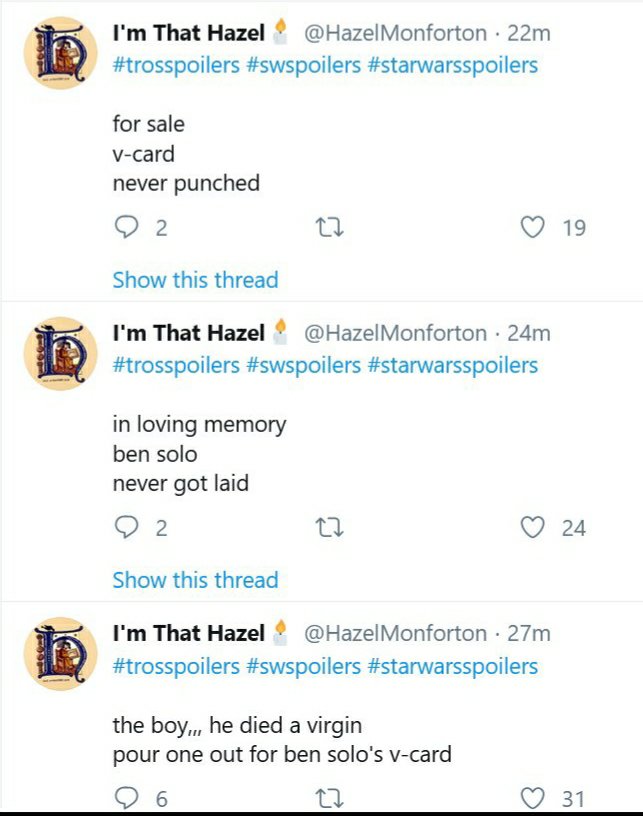
The day after the premiere of Star Wars Episode IX: The Rise of Skywalker (December 16, 2019), I watched a roughly seventy-second-long video of a young woman absolutely losing it over the idea that Kylo Ren – I’m sorry, Ben Solo – probably died a virgin.

I mean, she went on a whole tear about how this was actually about fighting for abuse survivors in the fandom to see someone like them make it to the end of the franchise (hello, Finn exists, binches) but like… at the end of the day, her real big beef with The Rise of Skywalker days before it actually got a wide release was that… Ben Solo didn’t get to plow Rey’s oh so fertile fields before becoming one with the Force.

That sentiment – that Ben Solo somehow deserves to get his dick wet in Rey and that The Rise of Skywalker somehow robbed him of the right to fuck when it’s obvious that he’s the ultimate Space Incel – is featured heavily across too much of that fandom’s response to the end of the film.

Read More »

Fleeting Frustrations #11 – True Fans, Who Fans?

True Fans Who Fans - Header

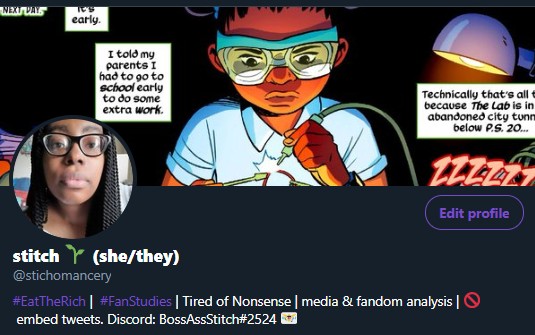
There’s nothing about my Twitter account that clearly pings the mind and calls me out as an obvious fan of K-pop – or… pretty much any form of nerdery outside of a single comic.

My profile picture is a picture of my face, not a Korean artist or a superhero. My display name and @ aren’t a fandom in-joke. (Although the little leaf/tree emoji in my display name is a reference to Kim Namjoon of BTS. I did it for his birthday in September and then… just never changed it.)

Stitch Computer687

I do get that the only notably nerdy thing about my twitter account is, at first glance, my header image of Lunella Lafayette from Marvel Comics’ Moon Girl & Devil Dinosaur. And if you don’t know anything about her comic, it’s easy to assume it’s not nerdy.

But between my apparently invisible fannishness and my very visible Blackness, no one ever assumes I know anything about K-pop. Or Star Wars. Or fandom.

The first thing is my thing, you know?

I’m into a ton of different fandoms and when faced with having to try and choose one to represent fully across my Twitter profile, I kind of froze and chose one thing. So that inability some fans have to recognize me based on my profile and whatnot? That’s on me.

But then there’s the thing where Black people aren’t necessarily read as fans across many different fandom spaces around the world.Read More »

[Post PCA Roundtable Wrap-Up] 10 Years After Racefail ’09: Where’s The Growth?

10 Years After Racefail '09_ Where's The Growth_

This is a wrap-up/write-up of my overall comments during the PCA 2019 Roundtable on Racism in Fandom/Fan Studies Spaces (which I chaired). Feel free to check out write-ups from Robin Anne Reid and Samira Nadkari, two of the other participants on the roundtable.


Across transformative and curatorial fandom spaces, racism is so entrenched in the skeleton of fandom – from erasing fans of color via the ahistorical rewriting of fandom history to killing off or torturing characters of color in fanworks – that to uproot and remove racism from fandom would leave it looking like those floppy cored sheep from the bone vampire episode of Futurama.

PCA 2019 was my second time attending this conference in three years. It was my second time coming into these academic spaces and getting up to talk to a hopefully invested audience about racism in fandom spaces.

But it wasn’t my first time talking about the way that misogynoir works in fandom.

Not in general.

Not even for that day.

(As I’d done my presentation on misogynoir the previous panel session)

Talking about misogynoir and other forms of racism in fandom and media is kind of… my thing.

It’s an aspect of fannishness that I feel proud of working on and where I feel compelled to continue honing my skills. It’s a form of fannishness that I like because I finally have the room and the words to verbalize my concerns as a queer Black person in fandom.Read More »

Short and Salty #1: They’re All About The Whiteness

Normally, I keep my saltiest thoughts to twitter or my Dreamwidth account. It’s better for all of us.

However, this salty thought is part of a currently shelved follow-up to my What Fandom Racism Looks Like article on Beige Blank Slates and I figured… “Why Not”.

So, have at it, friends and folks:

Attraction is supposed to be subjective.

This subjectiveness, in fandom, is used to say that attraction and desire can’t be connected to or criticized for on the grounds of morals or politics as if Black people weren’t legally prohibited from marrying outside of our race until the 60s and as if people of color aren’t seen as inviable partners to most white people.

Sometimes, when I look at the fandom darlings that fandom loves – the dark/light haired go-to duos like Aziraphale/Crowley (Good Omens), Merlin/Arthur (Merlin), and Hux/Kylo (Star Wars) – I genuinely question what I’m seeing and how subjective attraction is.

Across multiple Western slash fandoms, when you look at what gets popular and what characters just get the fans a-thirsting one thing stands out to me about their attractiveness –

The most attractive/appealing thing about these guys – or the thing fandom actually finds integral to their adoration – really is their whiteness.

Even if they won’t say that.

Fleeting Frustrations # 7: Archive Frenzy and Being (Un) Grateful To Our Fannish Foremothers (Stuck In 2002)

Note: This Fleeting Frustrations installment mentions racism as well as fanworks involving sexual violence and underage characters. It’s also not very nice. Obviously.


Fleeting Frustrations #7.png


There are things to love about the AO3. I won’t list them here because I don’t need to. Almost every single piece written about the big ole archive – especially in the wake of its 2019 Hugo Award nomination – has been positive. 

It’s been gushing. 

The AO3 is positioned as a site for queer and/or female exploration and empowerment.

It’s so amazing, these articles and adoring fans write, because it allows queer people and women the freedom to understand their identity and play around with sexual and gender roles as they figure themselves out.

We should be grateful to the grand ole archive because it gives us room to be queer, be women, and to explore kinks and identities that we can’t in real life.

Which is a cool story, let’s be real here.

If I wasn’t a queer Black fan who’s used the AO3 and been in fandom for most of my life, I’d even take those claims at face value. After all, a space for female and/or queer fans is pretty cool, right?

But what about the racism on the archive – in the form of fanworks or in how fans of color have talked about the response from archive staff volunteers have given when they talk about their experiences with racism on the platform?Read More »

“You Can’t Ship a Protagonist and an Antagonist”

Content Notes: This post is ostensibly about abuse (and how fandom assigns “abuse/r” labels based on the role a character plays in their respective narrative). I also quote dialogue between Jessica Jones and her abuser Kilgrave and discuss abuse related to Batman and the Joker. But the entire post is about abuse and it may trigger survivors so… Read carefully.


“You Can_t Ship a Protagonist and an Antagonist”

It’s a bit worrying that to huge swathes of fandom, the words “villain” and “antagonist” are now synonymous with “abuser”.

I’m a lurker by nature, so I’m always watching the way that fandom clings to or discards trends or tropes in their favorite source media and the fanworks that they produce about them. One thing I’ve noticed is that recently, within certain fandom spaces, the words “villain” and “antagonist” are more and more frequently conflated with the word “abuser”, something which I find worrying and frustrating.

In many fandoms, I’ve seen villains called “abusive” just by virtue of their being the villains. I’ve also started to see the terms “abuse”, “abuser”, and “abuse apologist” being thrown around willy-nilly to try to somehow show fans the error of their shipping ways (usually by calling them names or suggesting that they’re as bad as the fictional villains – or real life abusers in the accuser’s past).

Only that’s not how any of that actually works, but that’s not stopping it from happening in several fandoms that I’m in or have been adjacent to and I have… thoughts.

Read More »

[Flashback Friday] Dear Fandom, It’s Always About Race

I originally wrote this post over a year ago, back in May 2016. It was one of those period where I was seeing racism in fandom surge to a high level (this was after the meta of doom a certain BNF wrote) and I was just so fed up by how many people were dismissing our conversations about race and racism in fandom and saying “it’s not about race”.

So, I wrote an open letter that is sadly still relevant in fandom to this day.


Dear Fandom

Dear fandom,

It is ALWAYS about race.

No matter how you twist it, fandom’s collective and constant dislike of characters of color (especially if they’re in relationships/shippes with white male characters) for some reason you “just can’t put your finger on” is directly related to race.

Your race.

Their race.

Race.Read More »