This was originally posted on Patreon in November without any real extra-text.
One of the most interesting (and frustrating) things about talking about fandom and media and the racism present in these spaces is how many people view my position as one that has any power in fandom.
Few fandoms fill me with the kind of anger that the Star Wars fandom does.
In fact, there are times where I’d go so far as to say that I hate it.
Times like Wednesday night.
When I got home Wednesday night from my first A.C.E concert, I was flying high. It’d been a great night with fantastic music and a stellar performance. Everywhere I looked, I saw fans loving their thing and loving that they got to share that thing with other fans. For a few blissful hours, I’d experienced fandom at its best: people coming together in joy and in celebration over something brilliant.
And then I was rudely reminded that the Star Wars fandom exists and that a whole huge chunk of the Rey/Kylo shippers who dominate much of the fandom discourse is made up of just really terrible people.
I’m just so pleased about how well “hood cosplay” as a term works for my needs across my project on antiblackness in the k-pop industry and its fandom spaces. I had to do a video!
Back in in the beginning of April, when I first started this project and the idea for this section started to take form, I screenshot and shared a tweet from a K-pop fan (though the group they preferred, escapes me) that said:
“I don’t know why black people are even stupid enough to like K-pop. It isn’t for you. Go listen to rap.”
Go listen to rap.
Imagine having the nerve to tell Black fans to “go listen to rap” because – in this case – you were frustrated by yet another conversation about cultural appropriation in the K-pop industry.
Imagine being that much of a walnut that you zoom on past the fact that even the cutesiest of girl groups will have something that’s attempting to be a rap line and rap breaks in their songs – specificallyso that you can tell Black people to get the hell out of “your” fandom space/genre of choice.
This is just a taste of what international fandom spaces are like for Black K-pop fans on social media. When we are even a tiny bit critical of the way our idols try to emulate our cultures, folks tell us that we need to get out of the fandom because there’s no way that we belong.
They tell us to return to rap music, the same rap music that our favorite idols and artists are listening to and performing in South Korea.
The original thread is here but I have blocked tons of people to maintain my boundaries so I have copied the tweets over here for ease of access for people who still want to see the tweets but can’t because I’ve blocked them for whatever reason.
Like I absolutely get the sentiment behind “all fanfiction is okay” but I also have seen many antiblack stories across my lifetime in fandom where black characters are abused/objectified/enslaved/torn down usually by/for white characters-
And those stories AREN’T okay, friends. Like the sentiment “all fanfiction is okay” (like it’s fine, don’t worry about it, women are making it so let them have their fun) is one of those Lil Fandom Things that makes me wonder…
Do people realize that they’re leaving out a lot of people in those sentiments?Read More »
Over the past three years, I’ve documented multiple people who’ve used real world (offline) politics and historic and present atrocities to silence claims of dissent and derail criticism across different fandom spaces.
Police brutality, extrajudicial executions of people of color, and the school to prison pipeline are just a few examples of what people consistently repurpose across fandom in order to stop the critical ball from rolling.
Back in May 2019, I wrote an audiopost script about “Real Racism” in fandom and how people use the idea of “real racism” to derail people talking about racism in fandom spaces – which apparently can’t ever have racism in its borders.
To many people – who aren’t exclusively white members of fandom – the racism that many other people see and discuss in fandom spaces doesn’t count as “real racism”. Identifiable racism, to them, involves immediate physical pain to a real person of color, hate crimes, or traceable harassment from people saying clearly that they’re harassing someone because of their race.
To them, because much of what fans of color have detailed as fandom racism don’t involve those easily identifiable aspects that mark racism as a thing that only outsiders to fandom commit, they can’t acknowledge that fandom racism is real racism.
My appearance on Jinjja Cha was kind of destined to happen. I
adore Girl Davis immensely and want to be as cool as she is one day. And while
I haven’t had the chance to talk with April yet, we’re both longtime Rain and
Miyavi fans so like… we’re clearly also soulmates separated at
birth.
So, this was in the cards as a Thing That To Take Place.
Talking with Girl was an incredible experience in terms of
like… how it felt like just going out with a buddy and getting intense over
drinks. (One day, by the way, I’m going to have that experience with them. I
promise y’all that.)
Girl and I talked about a lot of different things across
our almost three-hour-long conversation. From my whole issue with that one
barbershop that was all over social media for a few days to that time I was
friends with a white supremacist in college a decade ago, nothing was really
off limits?
And I loved it.
The main question across our conversation was about finding
our thresholds as Black fans invested in these groups and this industry that
has repeatedly shown itself to be incredibly antiblack across the past twenty or
so years.
One of the things I’ve been thinking about – especially after reading and sharing Stan’d off by Claudia Williams – is how hard is is to unstan?
Even temporarily because you’re burnt out or frustrated by a member’s hood cosplay or upset at the way the performers/their companies never seem to notice antiblackness in their fandoms – but can leap to quash a dating rumor in a heartbeat.
A podcast dedicated to South Korean entertainment. Our goal is to be informative and to have an open and mature discussion about the things we love, hate, and love to hate. Most of all we want to have fun with Kpop and share that with others!
We are made up of netizens from all over the world and we gather weekly in our spare time. Sometimes we agree, sometimes we don’t, and we hope that you find yourself in each of our voices.
At the start of October, I had the honor of guesting on Not
Your Average Netizens’ episode “Chicken Noodle Soup For the K-Pop Lover’s
Soul”. In the fun and fantastic liveshow, we covered cultural appropriation
we see from idols and the antiblacknesss we see from fandom.
In both cases, we talked about “Chicken Noodle Soup”
(BTS’ J-Hope’s take on the 2006 song featuring Becky G) and the fandom’s
overwhelmingly blah and bad reaction to J-Hope’s gel twists or the art on the
single’s cover and Black fans who were annoyed at or offended because of any
aspect of the collaboration.
We also talked about how CNS is kind of exemplary of how
Black culture/creativity isn’t valuable to non-Black people until other
non-Black people partake of it and perform it. Like I’ve talked about this to a
bunch of people – and we brought it up here too – that if you’re “acting hood”
and dropping signals of Blackness in your video but you… probably have never
had a significant and intimate relationship with a Black person… how authentic is
your performance, really? Aren’t you just putting on a costume?
And why defend someone’s inauthentic portrayal of Blackness
when you’re consuming their content?
One of the recurring comments when K-pop fans talk about cultural appropriation as performed by idols is “so and so isn’t appropriating culture, they’re APPRECIATING it”. The idea that appreciation renders conversations about cultural appropriation null and void is clearly a belief that many of these people have and the thing is –
These idols probably genuinely appreciate what they know about Black culture, but when they go to take it into themselves and perform Blackness, that appreciation becomes appropriation.
This video talks about that appreciation often leads to appropriation in these circles, how j-hope’s appreciation in his and Becky G’s version of “Chicken Noodle Soup” sparked conversations about cultural appropriation and antiblack backlash in BTS’ big ole fandom, and why intent doesn’t matter when the impact is kind of harmful.
If you want to know more about my thoughts on the way Black hairstyles are appropriated within K-pop and why that matters, check out my video from August.
And of course, I’ve got my lengthy article on cultural appropriation for y’all to check out!
This isn’t entirely tied to the video’s content, but it’s related to what inspired me to put together this video:
The end of September, j-hope from BTS came out with “Chicken Noodle Soup” with Becky G. It’s an updated take on the 2006 song which was apparently one of his biggest inspirations as a dancer.
In the initial images that he shared (via BTS’s twitter
account), j-hope appears to have some kind of twists in his hair that are
clearly reminiscent of the kind of twists that primarily are associated with
Black hair – as in, Black people‘s hair.
I’ve been in my feelings since I saw those photos.
But then, I am always in my feelings about Korean idols
wearing hairstyles they think are necessary in their quest for authenticity in
hip-hop. Every single time it happens – and it happens often – I find my
feelings… bruised.
In this installment of What Fandom Racism Looks Like: Antiblackness in the K-Pop Industry and its Fandom Spaces, we’ll be doing some fast and furious foregrounding.
The point of this foregrounding essay isn’t to
provide readers with an exhaustive and complete history of Korean and/or African
American hip hop and popular music.
Here are the goals of this furious foregrounding essay:
to provide some context when it comes to what K-pop generally is for folks with a wobbly grasp
To briefly cover the history of Black creativity being exported to South Korea and beyond without Black influence (but with antiblackness),
To foreground myself and my experiences with this genre and the fandom spaces.
Let’s start with a quick coverage of what k-pop is from
two experts who’ve written books on it.
Context Matters
In the introduction to his monograph Sorting out K-Pop: Globalization
and Popular Music in South Korea, Michael Fuhr writes that:
K-Pop is mainstream music in South Korea. Initially modeled for the teenager market, this music of the country’s youth has become the most pervasive music in Korea, effectively shaping the sonic public sphere, the musical tastes among different generations, and the imaginative worlds of its consumers and producers. (3)
Then in Suk-Young Kim’s K-Pop Live: Fans, Idols, and
Multimedia Performance, she writes that:
In the broadest sense of the word K pop as an abbreviation for Korean popular music includes all genres of popular music that emerge out of South Korea. […] But in from 2009 onward, when the term entered a wide circulation, it came to designate a much smaller fraction of south Korean music. according to pop music critic Choe Ji-seon, it references “music dominated by idols dance music which strives to gain a competitive edge in the international market .in this respect indie music or rock or anything that does not belong to dominant Idol music usually is not characterized as K pop”. (8).
K-pop – as an industry and as a genre (smush), is a
multifaceted [thing] that really dates back to just under thirty years ago with
the term itself dating back to the mid-nineties. (Suk-Young Kim traces the term
to Hong Kong’s Channel 5 in 1995 and mentions that it follows in the footsepts
of the already coined and widely used “J-pop” [8]).
When I used to be on Tumblr, I’d get a lot of messages and reblogs from people who made it a point to let other people know that I didn’t speak for all POC.
I was never arguing that I did, of course, but it was imperative to these other people of color to let me and white people in fandom know that they were here, they weren’t white, and that they thought I was full of shit about fandom racism.
Which is their right as people on the internet, let’s be real here.
But it’s interesting:
I, a queer Black person with most of a lifetime in fandom and an entire academic career focusing on media criticism and representation, couldn’t possibly speak for every single person in fandom when I talked about racism I witnessed in fandom… but they could speak over me in order to let other people in fandom know that I was a POC Not To Be Trusted.
“Pick Mes” have a home on the internet. It’s a term borne from African American Vernacular English (AAVE) that calls to mind the mental image of people jumping up and down and begging to be picked for a game. (“Pick me! Pick me!”) Only, in the usual context, it’s someone leaping up and down and trying to get the attention of someone that treats them with disdain.
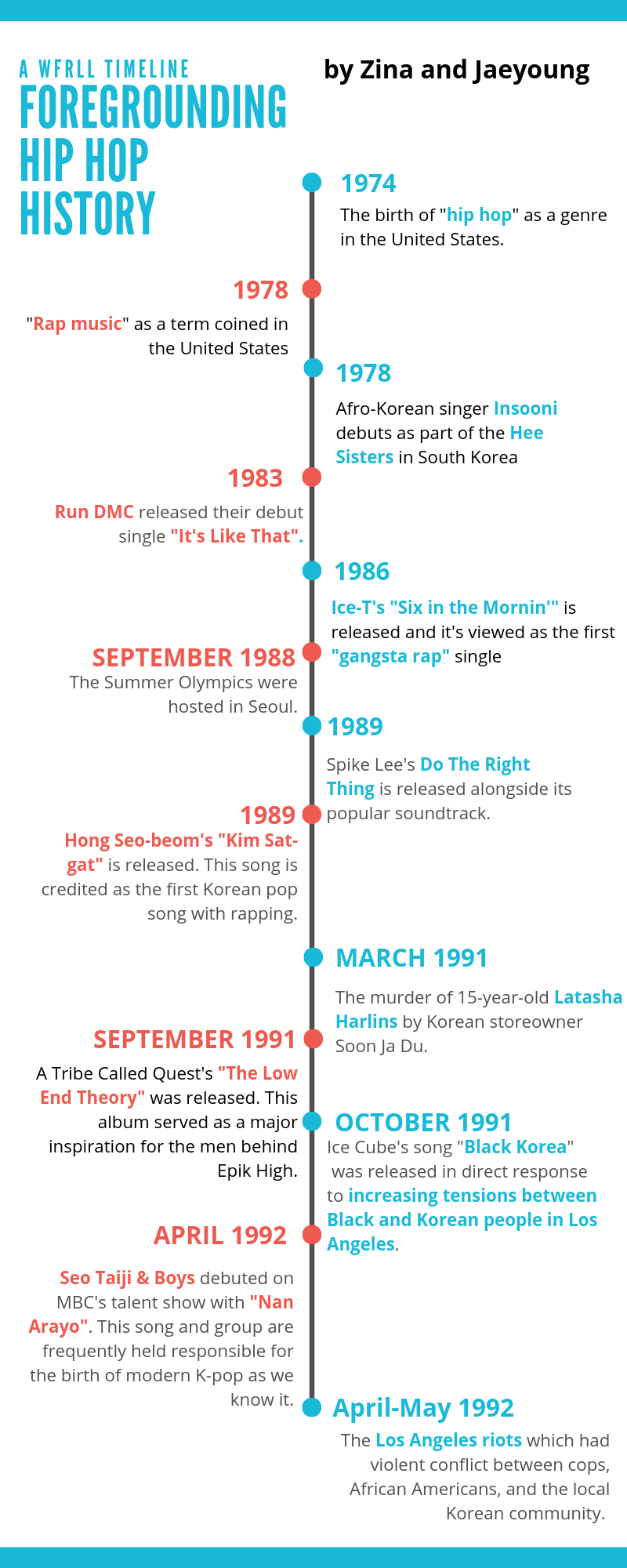
Note: This timeline is an attempt on my and Jaeyoung’s parts to show a trajectory and some major moments for hip-hop that potentially put these cultures into conversation.
As a result, timeline does not cover every single event that happened across Black and Korean hip hop history. Otherwise, it’d be book-length and I would be a hot mess from having to wade through my sources even longer.
(Please let me know if you need or want a PDF copy of this timeline and source post!)
While the foundations of hip hop music were laid in 1972/1973, multiple sources claim that the genre didn’t take flight until 1974. Further sources claim that Keith “Cowboy” Wiggins (from Grandmaster Flash and the Furious Five) actually came up with a name for the genre four years later in 1978
1978 – “Rap music” as a term coined in the United
States
This source claims that in 1978, the music industry coins “rap music” and shifts from DJs towards MCs. However the etymology of the word “rap” and the African (and African American) tradition of rhythmic speech (often) alongside beats dates back way further and we have evidence of Black artists dating back to the Sixties performing a spoken word style that they called “rap”.
Born in 1957 to a Korean mother and an African American GI, Insooni is a soulful diva that remains one of the most well-known performers in Korea. She’s a still-active singer who performed at the 2018 Winter Olympics. She’s important to mention at this point of the project because she’s also a household name and cultural icon within Korea now and a sign that Black people from Korea are known to the citizens.
Abstract Black Women, Hated: Layers of Misogynoir in Fandom Spaces As fandom spaces become even more active in asking for and creating positive representation about underrepresented identities (i.e., disabled people and queer people), one notable weak spot in fandom representation politics revolves around the reception towards and portrayal of Black women in fandom. Black female […]
I know what you’re thinking: this my third or fourth “Fleeting Frustrations” post in a row to talk critically about fandom or something a particular fandom does. I know it doesn’t seem all that fleeting and well… you’re right.
Because every single time I try to settle in the squee and have fun in my fandom(s), I’m reminded that Black people and characters aren’t respected in fandom.
This latest incident?
A Black Panther post-film story that pairs M’Baku up with a white female reader and portrays the Jabari as primitive and an author who apologizes to the person who requested the story – not the Black fans rightfully offended by the racist fanwork.








 Stitch's Media Mix
You must be logged in to post a comment.