Five Things I Want From Amazon’s Eventual Lord of the Rings Series

lord-of-the-rings-1510599906

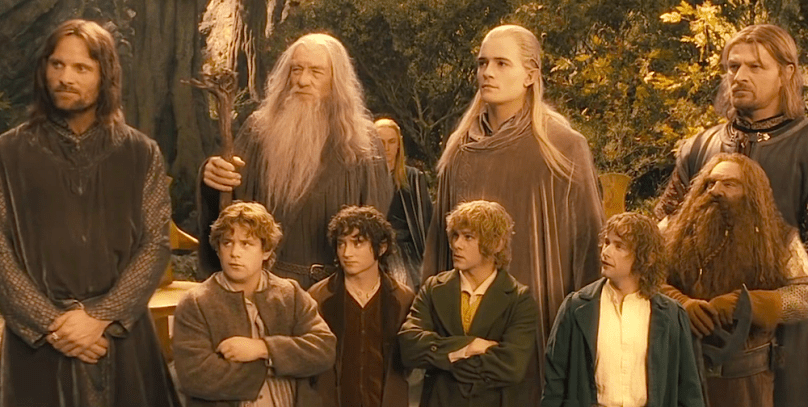
For some wild reason I can’t understand, Amazon has decided to start with a quarter of a billion dollar budget for their upcoming Lord of the Rings series. As reported by The Hollywood Reporter, that initial $250 million dollar deal is only the tip of the iceberg since, “When production expenses like casting, producers and visual effects are factored in, the series is expected to cost north of $1 billion”.

Shows with bigger budgets than most Hollywood blockbusters are a current “big” thing with HBO’s Westworld and Game of Thrones pulling in huge audiences and costing millions of dollars per episode. (Westworld$100 million price tag reportedly had a for its first season and Game of Thrones surely has surpassed that in all of their seasons.) Same goes for the BBC and Netflix series Troy: Fall of a City.

The thing about this newly locked in Lord of the Rings deal is that we’re at $250 million for a series we know next to nothing about and that’s kind of amazing. This is an expensive series that has the potential to go anywhere and do anything – within the confines of Tolkien’s worldbuilding.

So here are five things that I desperately want to see from this Lord of the Rings series that no one on this green-ish earth asked for.


Read More »

[Stitch Goes Places] Elizabeth Acevedo & Tomi Adeyemi in Conversation @BooksandBooks

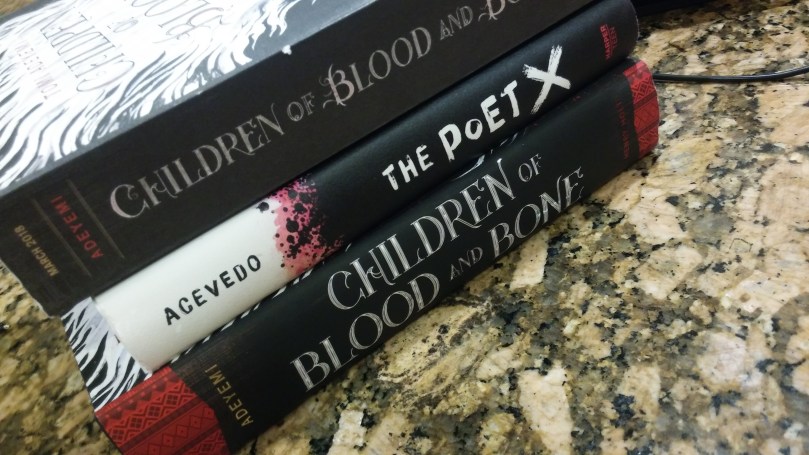
20180314_214944.jpg

I love book events. Talks, signings, readings… You name it and I’ll probably enjoy watching an author I admire and adore do it because I just think they’re cool.

So when news first dropped about Tomi Adeyemi going on a book tour to celebrate the release of her debut novel Children of Blood and Bone AND that she’d have a tour-stop in my lovely neck of the woods at local bookstore Books and Books AND that she’d be in conversation with the ridiculously talented Elizabeth Acevedo (whose debut novel The Poet X is also amazing), I got obnoxiously excited. Read More »

#NowWeRise – Children of Blood and Bone Blog Tour (Moodboard + Blogging Bits)

COBB Blog Tour Banner.png

You know, I think this might be the first time I’ve ever done a blog tour?

When I got the email about possibly doing something for the release of Tomi Adeyemi’s Children of Blood and Bone in its release week, I kind of like got all giddy. What a great opportunity to do something fantastic in order to celebrate one of my favorite books of 2018!

In Tomi Adeymi’s Children of Blood and Bone, the Ìwòsàn Clan is the clan of the Maji of Health and Disease. As a result of this totally awesome “Discover Your Magic” graphic, that clan is… my clan, but my majj power isn’t that of healing, it’s of inflicting disease.

My maji power (Cancer) is the magical equivalent of Typhoid Mary.

Which I find fitting because of my relationship with illness.

I’m honestly always sick.

Or suffering from something.

Right now, I’m actually pretty sure that I might even have the chicken pox. (Though… probably not as I was vaccinated as a child and I think that’s supposed to stop that from happening.)

So for me, there’s something absolutely captivating about the idea of maji whose power centers around causing illness instead of healing it.Read More »

While You Sleep: A Black Panther Drabble Collection

While You Sleep - Title Card (1)

Four times T’challa watched someone sleep and one time that the tables are turned.

Absolutely un-beta’d. Spoilers for Black Panther abound. The last two snippets are set between the end of the final fight scene and the last scene in California. They also diverge from the end of the film.

Content warnings for character death, trauma from character death, and implied violence.


i.

The first time that T’challa holds his newborn sister Shuri in his arms, he worries for a moment that he’ll drop her. Then she nuzzles close in her sleep, tiny lips parting with a smacking yawn, and he knows that he’d never hurt her. Not even on accident.

She’s hours old and so very small, warm and soft in the cradle of his elbow, her dark little face tucked up against his chest. She barely has any hair atop her head aside from a faint whisper of black hair that is pitch black and feather light against the dark brown of her skin.Read More »

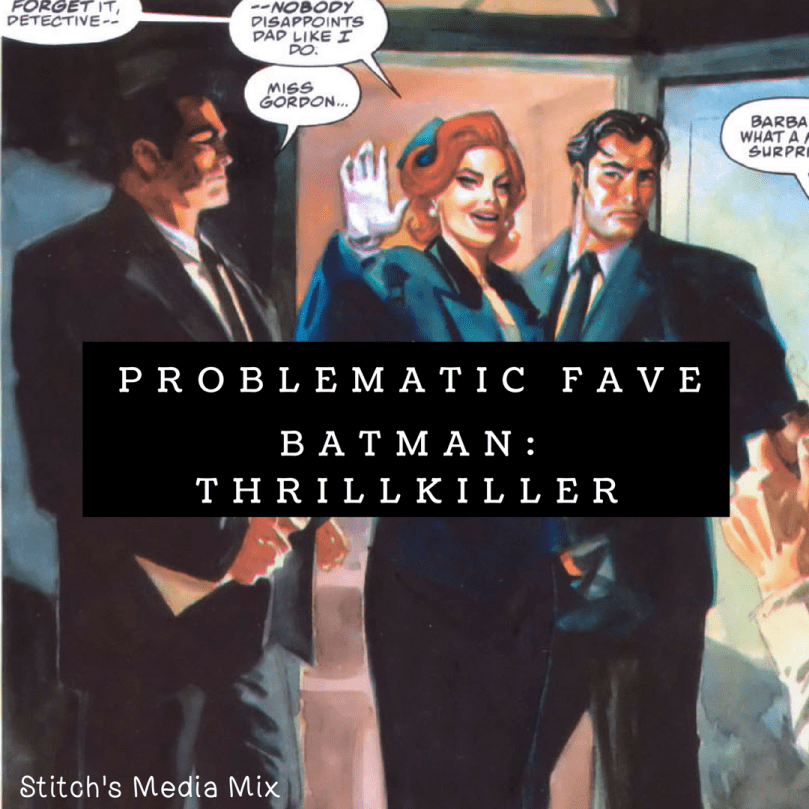
[Problematic Fave] Batman Thrillkiller

Content warning: I talk about two canonical ships that involve adults and teenagers (one in relative detail and the other not in specifics) and a reference to the writer’s transmisogyny in another series.


Problematic Fave - Batman Thrillkiller

Earth-37, the alternate earth that serves as the setting for Batman: Thrillkiller, was one of my favorite worlds in the DC Universe despite the fact that the actual story and art are… problems.

Back when I first read the miniseries, I think it hooked me with narration boxes that see our masked heroes juxtaposed against the transitional period that this Elseworlds tale exists in:

We tend to define our lives by the decades – the gay nineties, the roaring twenties, the depression thirties. The calendar reads 1961 – but it’s a time of transition. It’s not the fifties anymore – the decade of Ike, of McCarthyism, of Jack Kerouac – and it’s certainly not the nineteen sixties of the sexual revolution, of the war in Vietnam, of turning on, tuning in, and dropping out. Like the rest of the USA, Gotham was jumping with a giddy optimism – no one could guess at the dark days that lay ahead.

This first set of narration boxes is set against a backdrop of Gotham City, Batgirl and Robin at the top in shadow and the city they’re attempting to protect at the bottom. There’s something about watching comics try to establish a sense of realism and historical context in their works that just… entertains me. The next few pages establish the historical context of this Elseworlds — JFK is president, Elvis was discharged from the army, and the Beatles weren’t yet a thing. It’s a set of pages that immediately and successfully establish realism and a connection to the time period and it works.

Thrillkiller is a genre mishmash with elements of noir fiction, your sort of typical superhero story, and some air of the 1950s morality movie in the style of Reefer Madness. Which could be awesome except…

[Small Stitch Reviews] A Princess in Theory by Alyssa Cole

Technically, there are spoilers for Black Panther in this review… Right there at the top.


A Princess in Theory Cover

If you walked out of Black Panther on your first (or third) viewing and were hit by a craving for some sweet romance in the same vein as the sweetness between Chadwick Boseman’s T’challa and Lupita Nyong’o’s Nakia, boy do I have the book for y’all.

A Princess in Theory, the first book in Alyssa Cole’s new Reluctant Royals series, is a fantastic “lost royalty” story centered on the evolving relationship between a potential princess that doesn’t know her own past (but does know her way around a lab since she’s an epidemiologist) and the prince who happens to believe in happy endings (but needs to do a bit better about his big reveals).Read More »

Women of Color in Marvel Live Action Properties – Elektra Natchios

Women of Color in Marvel Live Action Properties is an essay series that will look closely at the portrayals of female characters of color by actresses of color in Marvel’s various franchises. I was inspired by the fact that a lot of these female characters don’t get anywhere as much love as white female characters in similar roles and that we’re not as likely to see fandom analyze why they’re empowering. They don’t get meta-fandom or essays unless it’s about placing them in relation to white characters. I want to celebrate the women of color that inhabit the same worlds as our favorite superheroes while looking at how and why they’re important to fans like me.


WOC in MCU - Elektra (2)

Alexandra Reid: Her name was Elektra Natchios. You are not her. You are much more than she ever was. There was a man. They call him the Devil of Hell’s Kitchen. And in this other life, he let Elektra die.

Defenders Season 1, Episode 6 “Ashes, Ashes”

Elektra Natchios deserves better than Daredevil – the show and the character.

Introduced in Daredevil’s second season episode “Kinbaku”, Elektra is an old flame come back to burn Matt Murdoch, appearing in his apartment under the pretense of asking for a favor from the man she once cared about. Elektra is a morally grey character, a complex figure who disrupts Matt’s life just by existing.

She’s also a survivor of childhood abuse that includes neglect, manipulation, and violence from a parental figure, something that she has not been allowed to cope with. Elektra’s mistreatment by Stick, a man who serves as an abusive pseudo father figure for both her and Matt, is a significant element in the latter half of Elektra’s appearances in Daredevil and yet his abuse’s effect on her relationship and mental health are largely glossed over.

Her complexities as a character who has survived horrible mistreatment and who has been shaped into and used as a tool by two different sides in a war largely wind up not getting their fair share of attention in plots dominated first by Matt Murdoch alone and then the entire crew of the Defenders.

For this essay, I’m going to talk about Elektra as a complex anti-hero, one whose status as a survivor shapes her characterization and her approach to relationships.Read More »

Queer Coded Villains Aren’t That Awesome

Queer Coded Villains Aren’t That Awesome.png
AKA “Hux and Kylo aren’t the queer coded villains you’re looking for”

I woke up  on MLK Day swearing that I’d dreamt up a tumblr post where someone quoted Martin Luther King Jr. in order to defend Hux, Kylo Ren, and the First Order. When I went through my archives, not only did I find out that the post was real, but I then stumbled back over a post I made in response to one arguing that Star Wars’ Hux was coded as queer and that said queer-coding was a good thing.

And I mean –

A fair amount of people not only read Kylo Ren and Hux as queer-coded within their canon, but:

  1. Queer coded villains are actually kind of shitty and they definitely shouldn’t be something to aspire to or admire, and
  2. I don’t know how they leap to that conclusion of Hux and Kylo as queer coded in the first place.

For one thing, there’s a difference between a character – especially a villain – being coded as queer in their canon (typically via stereotypes about femininity/masculinity, style of dress, speech, interactions with other characters) and a queer fan deciding to read a character as queer because they see themselves in the character.

If they’re actually present in canon, queer coded villains typically come from a place of homophobia – conscious or otherwise. They come from a fear of supposedly non-normative genders and sexualities and from society straight up repurposing queerness (or stereotypes about queerness) as a go-to for “spooky and scary” because well –

Heterocentrism kind of needs to portray queerness as a dangerous avenue to stroll down.Read More »

When will it finally be an acceptable time to talk about gun violence?

Today, at Marjory Stoneman Douglas high school in Parkland, Florida (the school I did my student teaching in back in the beginning of 2015), a young man with access to an AR-15 and a ton of ammo shot multiple people.

So far, seventeen people have died.

Children have died.

Children have fucking died.

And yet, it’s still somehow not the right time for the US Government to do something about the gun violence that plagues our country and kills children in the safest of spaces.

And the thing that gets me is that it’s somehow never the right time to talk about this violence or to how we can do something about it.Read More »

The Consort – Chapter Two

THE CONSORT

Iirin meets the two gods that he is apparently destined to bond with and realizes that he really has no idea how to handle what will come next.

Between the moment when the carriage finally slowed to a stop and when its door opened with a muted snap, Iirin managed to come up with and discard nearly a dozen different scenarios where his introduction to the two Tals could go terribly.

Jolted out of his dark thoughts, Iirin found himself gaping up at the man that opened the door for him.

At the temple-orphanage, Iirin was the tallest inhabitant, and even when he did errands in the marketplace, he rarely saw anyone that approached his height in the bustling crowd. However, the man in front of him looked as if he almost could be several inches taller than Iirin if they stood side by side.

In addition to that stunning height, the man before him was striking, with curly dark green hair, warm brown eyes, and light brown skin several shades lighter than Iirin’s own complexion with an undertone of greenery flickering just underneath the surface.

He was also, Iirin realized when eyes met, not a regular demon.

Or even a demon at all.

Iirin had been expecting a servant to help him out of the carriage and introduce him to his future bonded, not one of the two gods themselves.Read More »

[Guest Post] Finn as everyman? How about no?

Finn as everyman - Guest Post Header.png

After the release of The Last Jedi, there was a noticeable shift in how members of the general audience discussed Finn – if they talked about him at all. People who resented his inclusion in The Force Awakens – viewing him as a sign of P­C culture run amok or as an extra whose sole purpose was to diversify the cast – had little to say this time around, likely because his marginalization in the series’ latest installment merely served to confirm their negative view of his place in the trilogy.

Instead, it was those viewers who claimed to like Finn whose tune changed.

As it became clearer that Force sensitivity would never be part of his arc, at least not in this segment, there arose a collective sigh of relief from certain quarters: “Good! He doesn’t need to be Force sensitive to be important. Let him just be Finn. Let him just have a blaster and kick ass that way. Let him be the everyman the audience can relate to.”

Except that – to paraphrase Luke Skywalker, as he faced off against Kylo Ren in The Last Jedi – “Amazing. Every word you just said is wrong.”Read More »

[Book Review] Let’s Talk About Love by Claire Kann

20180204_201605.jpg

Title: Let’s Talk About Love
Author: Claire Kann (Twitter)
Genre: Contemporary, Queer Fiction, Queer Romance, Ace/Aro Representation
Rating: Highly Freaking Recommended

Publisher: Swoon Reads/Macmillan

Publishing Date: January 23, 2018

LINKS: AMAZON | BARNES AND NOBLE

SYNOPSIS

Alice had her whole summer planned. Non-stop all-you-can-eat buffets while marathoning her favorite TV shows (best friends totally included) with the smallest dash of adulting—working at the library to pay her share of the rent. The only thing missing from her plan? Her girlfriend (who ended things when Alice told her she’s asexual). Alice is done with dating—no thank you, do not pass go, stick a fork in her, done.

But then Alice meets Takumi and she can’t stop thinking about him or the rom com-grade romance feels she did not ask for (uncertainty, butterflies, and swoons, oh my!).

When her blissful summer takes an unexpected turn and Takumi becomes her knight with a shiny library employee badge (close enough), Alice has to decide if she’s willing to risk their friendship for a love that might not be reciprocated—or understood.


REVIEW

Straight up, I wish that I’d had Claire Kann’s Let’s Talk About Love back when I was a teenager trying to figure out who I was and what the heck I was doing. Like me, Alice is the baby of her family. She’s the youngest daughter and a surprise baby to her parents who have to be in their mid to late fifties in Let’s Talk About Love.

This book seriously matches so much of my experience as a queer, Black, lady-oriented person that’s on the ace-spectrum that I kept having to put the book down in order to squish my own face.

(In case you didn’t know, face squishes are the HIGHEST sign of my pleasure when reading.)Read More »

What Fandom Racism Looks Like: The Smartest Girl in the World Has To Be A Mary Sue

Fandom Racism - Mary Sue

On the first day of Black History Month, a random writer on Archive of Our Own gave to me… two separate stories that framed Shuri – T’challa’s brilliant baby sister in Black Panther –  as a character that couldn’t possibly be as smart as the MCU claims and as a victim of child abuse by the Wakandan elite who are “taking advantage” of her brilliance.

These stories were written in response to Black people calling out the author’s racism in deeming Shuri a Mary Sue in Black Panther in a tumblr post (that used the Black Panther tag) and subsequently writing off the film.Read More »

The Great Big Anita Blake ReRead – The Lunatic Cafe

Content/Trigger Warning: References to sexual violence, sex work/er shaming, and well… a snuff film in the text that I describe in medium detail. I still can’t believe it was in the book. I cover the ableist language in the title in the bonus section alongside a bunch of other stuff that I found frustrating about the novel, but that wasn’t related to my angle.

title_The_Lunatic_Cafe.jpg

Lycanthropes are nothing if not practical.

— Anita, woefully understating the circumstances behind a snuff film released into the US Underworld. Lycanthropes aren’t practical. If anything, in the Anitaverse, they’re largely actual monsters.

While the previous Anita Blake novel introduced lycanthropes on the large scale, The Lunatic Cafe is the novel that really introduced some of the messed up facts of life as a shapeshifter in Anita’s world.

The one main question that The Lunatic Cafe appears to ask throughout the narrative is whether or not shapeshifters are truly human (like “we” are). It’s a question asked in almost all of the shapeshifter focused books in the series and one that tends to glean different answers depending on the novel and the characters essentially posing the question.

In this book, the answer is… kinda, sorta, not really.

Read More »