Luke Cage – Looks Like A Cinnamon Roll…

Note: This piece largely revolves around sexual racism and the sexual objectification of Black male bodies. There are references to sexual assault, descriptions of objectified Black bodies, and a link to an article on the “Brute Caricature” that includes images of lynchings.


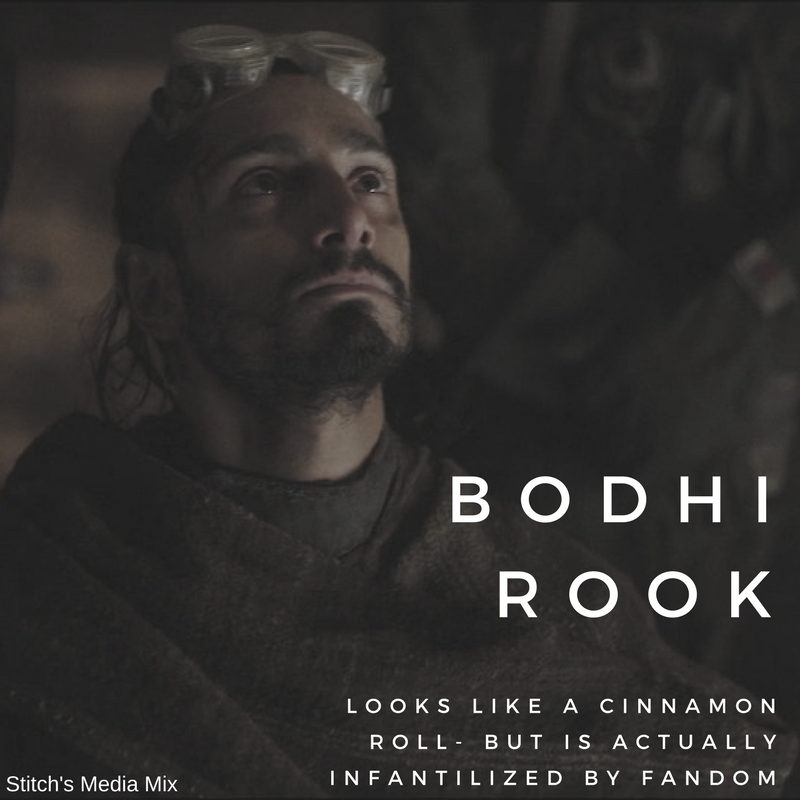
Looks Like a Cinnamon Roll - Luke Cage (1).png

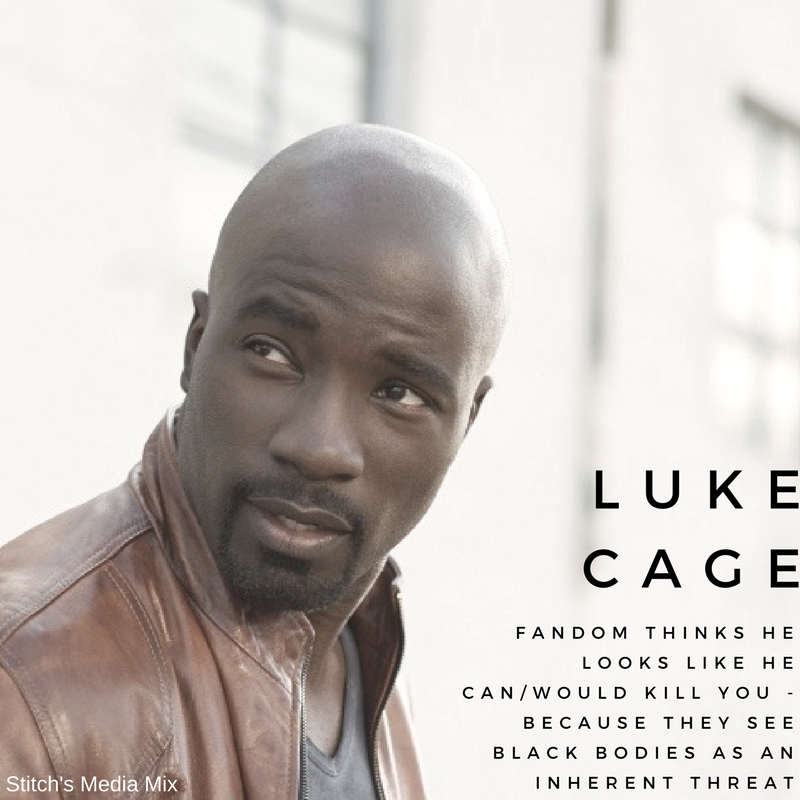
Fandom seems to think that Luke Cage “Looks like he could kill you, but is actually a cinnamon roll”.

To them, Luke may read as a threat, “but is actually a cinnamon roll” because they see that he has tender and sweet moments throughout his appearances in the Marvel Cinematic Universe. As a result, fandom sanitizes his character so that it can fit this super narrow archetype about what he should be – all while assuming that he was a threat to begin with.

I’m assuming that most, if not all, of the nuance written into his characterization in Luke Cage just went right over their collective heads because a huge chunk of Luke’s arc in his solo series revolves around him trying to figure out how to effectively use his body (rather than having other people use it).

At several points, the series actually addresses Black masculinity and how Black men are inherently seen as violent threats just by existing. And yes, Luke is one of the heavy hitters of the MCU, but he doesn’t want to hurt people: he’s just constantly backed into positions where he has to use his strength to hurt people in order to protect the people in his life.

I’m also assuming that the people who look at Mike Colter and immediately go “wow, this guy looks like he can kill me” haven’t watched the news in a while to see what many killers these days look like. They also have zero common sense because Mike Colter hardly looks like he could hurt a fly.

Saying that physically powerful Black characters such as Luke Cage and American Gods‘ Shadow Moon (played by biracial Black actor Ricky Whittle) “look like they could kill you” prior to calling them cinnamon rolls seems harmless and endearing, but can be linked back to the fact that their bigness and their Blackness are what cause white audiences to view them as threats in the first place.

It’s only after these characters prove their value and their softness (usually in a way that appeals to whiteness), that they’re revered for cinnamon roll status.

But it’s rather clear why fandom does this.Read More »

[Stitch Elsewhere] “Rupert Wong and the Ends of the Earth” Review @ Strange Horizons

Rupert Wong and the Ends of the Earth

To the gods and ghouls that he cooks for, Rupert Wong is little more than a mouthy piece of meat. At best, the titular character of Cassandra Khaw’s gloriously gory series hardly registers as anything more than an annoyance. At worst, he’s viewed as a tool to be used up, until he can only serve as fuel and food for divinity.

Part of Abaddon Books’s shared “Gods and Monsters” universe, the sequel to Khaw’s 2015 novella Rupert Wong: Cannibal ChefRupert Wong and the Ends of the Earth plucks main-character Rupert Wong from the familiarity of his life in Kuala Lumpur, dropping him headfirst into a conflict between some heavy hitters of the Greek pantheon and members of a mysterious organization known as Vanquis. Persona non grata in his hometown due to events in the previous book that lead members of his own pantheon to view him as a traitor, Rupert is removed from everything that is familiar and is transplanted, rather abruptly, to a dreary London neighborhood that seems downright lousy with Greek gods and figures from other European mythologies.

There are two huge things that Cassandra Khaw does in Rupert Wong and the Ends of the Earth that make the book—and the characters that inhabit it—too interesting to walk away from. First, there’s what drew me to Khaw’s writing in the first place: how she writes about flesh and food in a way that makes reading about the go-to nourishment of ghouls and gods a chilling, but captivating experience. Then there’s the way that Khaw writes the remains of the Greek pantheon struggling to gain a foothold in a world that has largely written them off as obsolete—and whose new gods are far less open to sharing.

If you’ve been paying attention to me at any point over the past year, you probably noticed that I’m a bit… fixated on cannibalism in fiction. From Tokyo Ghoul to Hannibal to an actual non-fiction book about how very natural cannibalism is, I’ve been hip deep in media and non-fiction centering the subject. It’s been great and gross!

Back in 2015, author Cassandra Khaw (who happens to be one of my pals on top of being a fantastic writer)  wrote a novella called Rupert Wong Cannibal Chef and I’ve been a huge fan ever since. And when the sequel came out this year, well… I just had to review it. When else would I get to talk about one of my favorite writers’s work, cannibalism, and Greek mythology?

Head on over to Strange Horizons to read my review of Cassandra Khaw’s gloriously gory Rupert Wong and the Ends of the Earth today!

Rayne: A Racist Rando on my Lucifer Review

ScreenHunter 25
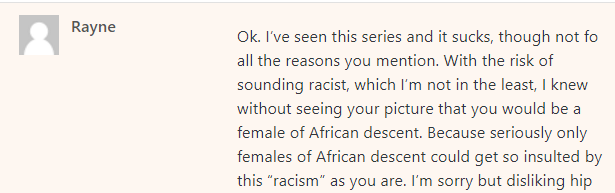
Rayne isn’t racist but she just knew that I’d be a “female of African descent” because I… talk about “racism”. Wow. That’s totally not racist at all — oh sorry, I meant that it’s pretty racist and that Rayne can kiss my ass. 🙂

Imagine being so incensed by some random person on the internet’s almost two-year-old review of a pilot episode of a show that’s now starting season two that you write them not one but TWO separate comments explaining in detail how subpar you view their intelligence and accusing them of being easily traumatized by media.

Monday, after my mother and I finally got back home after waiting out Hurricane Irma in a shelter, some random person on the internet decided that that was the best time to try and school me on my initial review of Lucifer’s pilot episode.

This woman, Rayne, wrote me two separate comments insulting my intelligence, my ability to understand dark aspects of fiction, and my understanding of misogyny and anti-black racism as a Black woman. Their two comments were insulting and unwarranted and at no point bothered to point out actual issues with my review (like the fact that I based my review on a leaked pilot episode…).

And this was all over a review I originally wrote two years ago for a show that I’ve since watched past the pilot and found interesting (if predictable).

Clearly, Rayne wanted attention so that’s exactly what I’m going to give her.

Join me in dissecting her comments and feel free to make fun of them in the process.Read More »

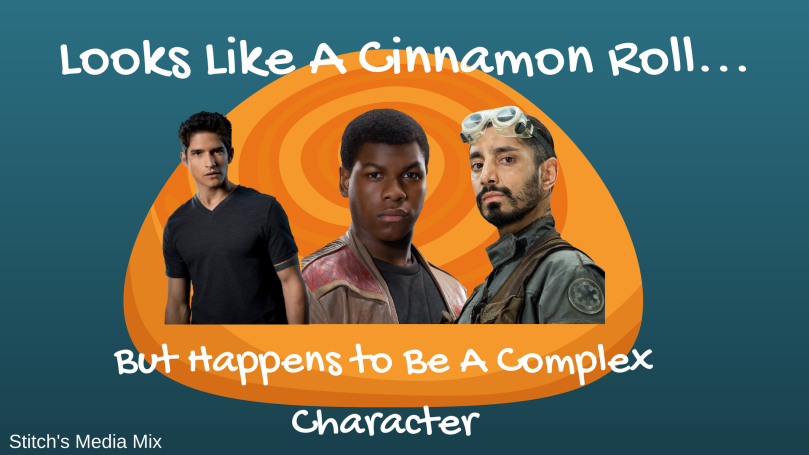
Finn – Looks Like A Cinnamon Roll…

In “Cinnamon Rolls, Sinnamon Rolls, and Capable Killers: How to Categorize Your Favthe author gives the following description for the “True Cinnamon Roll” (which falls under the “Looks like a Cinnamon Roll, Is Actually a Cinnamon Roll” part of the meme):

A true cinnamon roll really is as innocent and well-meaning as they appear. They can be completely naïve or somewhat sly, or may have the most common sense of the group, but most importantly they are more of a nurturer and healer than a fighter.

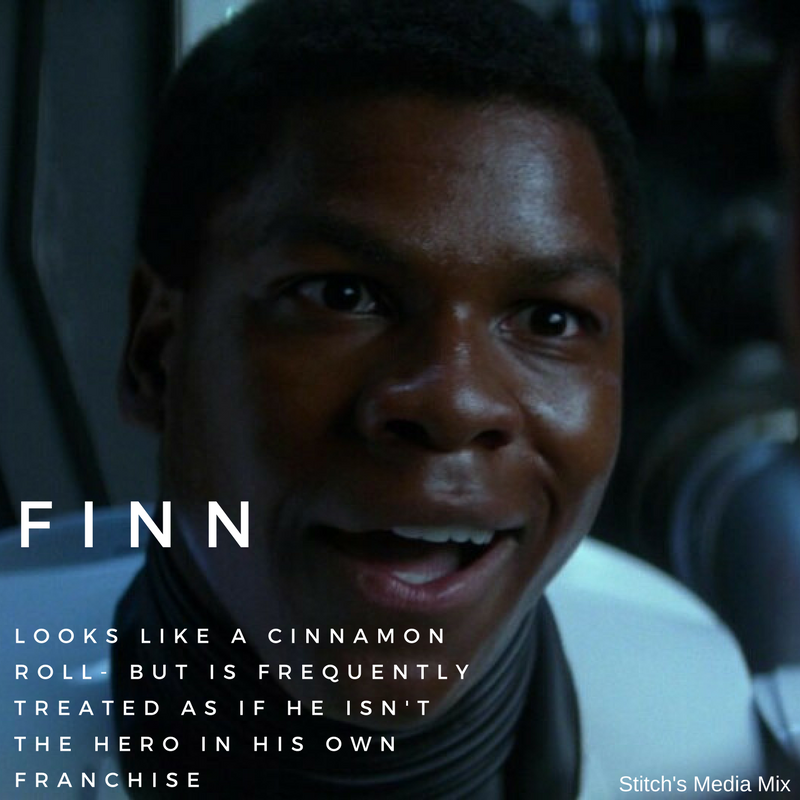
Throughout much of the Star Wars fandom in the wake of Star Wars: The Force Awakens male lead Finn (played by John Boyega) has been assigned the marker of the “True Cinnamon Roll”. Here’s the thing, I get where it comes from and as with Bodhi, I think that it comes from a well-meaning place but doesn’t bother to reckon with intersectionality or the reality of how Finn is treated by a significant portion of fandom both on and off of Tumblr.

Despite being the male lead of the film, Finn is not the most popular new male character in the fandom. He’s not the most respected. He’s not even the most written about. Right now on the AO3, Finn is the sixth most popular character represented in the fandom with 7150 appearances so far.

(Minor antagonist Armitage Hux (who only had about 3 minutes of screentime in The Force Awakens) has over 3000 more tagged appearances than that.  I’m never going to stop having a problem with that.)

Let’s look at that definition of the true cinnamon roll again.

At first glance, Finn being equated with a trope predicated on innocence seems pretty great because we live in a world where Black people are assumed guilty even in situations where they are the clear victims of violence. However, fandom doesn’t exist in a vacuum and what appears to come in good faith frequently… doesn’t.

Just because some people honestly view Finn as a cinnamon roll character while not forgetting his character from the film and related supplemental materials, that doesn’t mean the entire fandom does.

In viewing Finn as “a true cinnamon roll”, fandom ignores his actual characterization. Most frustrating, is that many members of fandom ignore that he is a complex character who is literally trying to find his place in the world. It’s a way to look like they care about Finn as an archetype (who is so pure, so perfect, and so put together, that the fandom simply must fall for “bad boy” characters like Hux or Kylo) without needing to care about Finn as a character.Read More »

I do not “agree to disagree”

There’s a guy in my Monday night class.

He was in my Monday night class last semester.

And his big thing, his huge thing, is looking at the other side and agreeing to disagree when people get angry with what he’s saying or point out that he’s just… being a dick in the interest of exploring whatever it is that he thinks he’s exploring. He did it all of last semester in our class on “the everyday”, in the hallway when my friends and I were talking about literally anything, and on facebook when someone has an opinion and he feels like playing the Devil’s advocate pro bono.

And he did it yesterday during our first class of the semester when we were talking about the status of Confederate statues/monuments around the US and I swear, I nearly stroked out from anger.Read More »

[Essay Series] Looks Like A Cinnamon Roll… – Opening Essay

Looks Like A Cinnamon Roll...

There’s a part of my brain that can’t believe that this all began because of an overused meme. There’s a part of my brain that’s almost embarrassed that I was able to  build so much content as a result of scrolling through character tags on tumblr and taking in the way that some of my fellow fans were talking about characters of color via the “cinnamon roll” meme.

Pulled from the title of an Onion article turned meme, the “cinnamon roll” in fandom is a character who is literally seen as being too good and too pure for this world. While different people in different sub/fandoms can’t decide on a uniform meaning or usage of the meme, one thing that the meme has come to represent is that the different “cinnamon roll” characters tend not to get the same content as other characters.

Unless they’re designated as a “sinnamon roll” (who is often a problematic character, usually a villain), these characters get “softer” content and they’re typically coddled in the ships fandom does popularize for them.

It’s a meme-turned-trope that should be adorable and sweet because well…

Everyone loves a cinnamon roll.

However, when those characters are characters of color well… it can become a problem.Read More »

Luke Cage and Claire Temple: Not Your Mammy Figures

StitchSnap-00005.png

I’m used to seeing posts where Black characters are reduced to nannies for white characters, but this post I found in the “Claire Temple” tag on tumblr really took the cake:

“Something I totally see happening in Defenders is Claire telling Luke about how Danny “has some serious issues and needs professional help” and how he should “watch out for the kid”, but of course Luke was already doing something like that…

Look, what I’m saying is that Luke is the kind of wise, experienced and calm person that Danny could have such a healthy relationship with and I can’t wait to see them interact. >.<“[1]

Let’s talk about this.

Let’s talk about how this person wants Claire and Luke to serve as mentors for Danny, a grown ass man who is capable of everything except maneuvering around adulthood. Let’s talk about how this sort of outlook – where Black characters are expected to serve as desexualized nanny figures for white characters – is par for the course in fandom.

There are three recurring black characters across the MCU’s Netflix series: Claire Temple, Luke Cage, and Misty Knight. That’s it. Three black characters that’ll come into contact with Danny Rand and two out of the three are frequently repurposed specifically so that they can take care of white characters[2].

Luke and Claire aren’t here for your inability to visualize them as full characters outside of the Mammy/Magical Negro archetypes and they certainly don’t owe this dollar bin Danny Rand a damn thing.Read More »

[Book Review] Miles Morales – A Spider-Man Novel

Miles Morales Cover

Title: Miles Morales: A Spider-Man Novel
Author:
Jason Reynolds (Twitter)
Rating: Super Highly Recommended
Genre/Category: Superheroes, Slice of Life, Spider-Man, Young Adult, Race and Representation
Release Date: August 1, 2017

Publisher:  Marvel Press/Disney Hyperion

Order Here: AMAZON (KINDLE)  | AMAZON (HARDCOVER) | BARNES AND NOBLE

Note: I received a review copy of this book from the publisher in exchange for an honest review and that’s what you’re getting.

SYNOPSIS

“Everyone gets mad at hustlers, especially if you’re on the victim side of the hustle. And Miles knew hustling was in his veins.”

Miles Morales is just your average teenager. Dinner every Sunday with his parents, chilling out playing old-school video games with his best friend, Ganke, crushing on brainy, beautiful poet Alicia. He’s even got a scholarship spot at the prestigious Brooklyn Visions Academy. Oh yeah, and he’s Spider Man.

But lately, Miles’s spidey-sense has been on the fritz. When a misunderstanding leads to his suspension from school, Miles begins to question his abilities. After all, his dad and uncle were Brooklyn jack-boys with criminal records. Maybe kids like Miles aren’t meant to be superheroes. Maybe Miles should take his dad’s advice and focus on saving himself.

As Miles tries to get his school life back on track, he can’t shake the vivid nightmares that continue to haunt him. Nor can he avoid the relentless buzz of his spidey-sense every day in history class, amidst his teacher’s lectures on the historical “benefits” of slavery and the importance of the modern-day prison system. But after his scholarship is threatened, Miles uncovers a chilling plot, one that puts his friends, his neighborhood, and himself at risk.

It’s time for Miles to suit up.

REVIEW

Jason Reynolds’s Miles Morales: A Spider-Man Novel is the kind of Miles Morales content that I’ve been craving since the second Brian Michael Bendis had Miles straight up not get that him being “the Black Spider-Man” was significant representation for kids.

Reynolds’ novel portrays a version of Miles that fans of the character (and some of his lingering detractors) need to be reading. It is, easily, a portrayal of Miles that is more honest and authentic than any we’ve seen so far. Reynolds’ imbues the novel (and Miles’s life) with details about his day to day life at home and in school, giving us a look at Miles’s life that we so far really haven’t seen in the comics themselves.

What’s fantastic about Miles Morales, is that this is a novel where we really get to know not just Miles, but the people around him. When Spider-Man Homecoming came out, everyone was beyond pleased with the fact that we had more time with Peter and his friends and in his neighborhood than ever before.

We got to know the kid under the mask.

That’s what Jason Reynolds does for Miles.Read More »

Totally Anecdotal: Stitch’s Brush With Racism in Education

I wanted to start my review of Jason Reynolds’ Miles Morales: A Spider-Man Novel with a slightly relevant anecdote on an experience I had as a teenager.

As an adult that was once a Black kid in the US education system (in Florida, natch), one racist teacher can make your school life a living hell even if they’re not part of a creepy (but absolutely plausible) plot to disenfranchise and subjugate Black people. So I wanted to talk about that.

But this got long and no one wants to read this sort of thing literally on top of a review so…

Separate post!

border

Ten years ago I was a senior in a mediocre charter high school. I was sixteen and had just skipped a grade (taking 11th/12th grade English at the same time) so that I could graduate early. Up until this point, all of my teachers were aware that I had “Bored Genius Syndrome” and that if they didn’t keep me engaged in the school work, something else would.

So they kept me busy.Read More »

Links I Loved – July

I have returned with another bunch of links that I found interesting, useful, and awesome! This July, much of the reading I did was on intersections of race and sexuality. Several of the articles that I read talk about homophobia and racism and include slurs, particularly the pieces on Lafayette Reynolds and on the Mayweather/Mc Gregor fight. The “White Women in Robes” piece also contains descriptions of sexual and reproductive violence.


Links I Liked - July.png

On ‘Baby Driver’ and black retribution hidden behind white privilege

Baby Driver is a dynamic film supported by tour-de-force editing, wild car chases, inventive cinematography, an eclectic soundtrack (everything from Queen to the Commodores) that carries with it the stale odor of white privilege as its guiding thematic principal that allows it to show a white male criminal character, complicit in vicious murders of law enforcement,large-scale robberies, carjacking and property damage, receive a light sentence and get paroled into the waiting arms of his beloved girlfriend.

“The Keeping Room” Succeeds Where Sofia Coppola’s “The Beguiled” Fails (This essay contains descriptions of sexual assault.)

Sofia Coppola’s newest film and remake of The Beguiled sets itself apart from both the 1966 novel and the 1971 original film adaptation in terms of style and tenor, but carries the same themes of solitude and fear. Most significantly, it brazenly disrespects its original source material and the history that it drew from by removing an enslaved Black woman, Hallie, from a narrative about women in the Confederate South during the Civil War.

Read More »

The Consort – Prologue

THE CONSORT

Iirin receives a visitor that will change his life forever.

On the Moonsday morning that changed Iirin’s life, the kitchen that fed the temple-orphanage’s dozens of inhabitants was empty. The lack of noise and of the usual clattering noises of chaos from the staff should have been an omen to Iirin, a sign that everything as he knew it was soon to change.

Instead, Iirin was busy making breakfast for almost three dozen hungry little demons because the temple-orphanage’s half a dozen cooks and assistants were nowhere to be found and as always, Iirin had been left in the dark about everything beyond what time Matron wanted him to be at work in the kitchens.

Halfway through preparing the weak rice porridge for the littlest ones who were still teething, the doors that connected the kitchen to the dining room flew open with a bang that made Iirin flinch and nearly drop his ladle into the bubbling porridge.

“I knew I’d find you in here,” Matron said, her voice a taunt that never failed to make Iirin’s jaw clench. She spat the words out as if she was accusing Iirin of some horrible deed rather than yelling at him for doing the very task that she’d told him he was responsible for only the night before.

Iirin never stopped stirring the porridge, only half-turning so that he could look at Matron’s livid face and the twin pinpricks of red that brightened her cheeks.

“Matron,” Iirin said, dipping his head in a shallow show of respect that the demon in front of him had never once tried to earn. “What is it that I’m being accused of this time?”Read More »

[Book Review] Oversight (The Community #2) by Santino Hassell

Oversight Cover

Title: Oversight (The Community #2)
Author:
Santino Hassell (Twitter)
Rating:
Highly Recommended
Genre/Category: Urban Fantasy, Queer Fiction/Romance, Psychics
Release Date: June 26, 2017

Publisher: Riptide Publishing

Order Here: RIPTIDE PUBLSHING | AMAZON

Note: I received a free copy of this novella from the publisher in exchange for an honest review. All of the views in this review are my own. There are mild spoilers in this review, but for the most part I leave the big stuff a mystery. Additionally, if you haven’t read the first book in the series, go do that now!


SYNOPSIS

Holden Payne has it all . . . or so he thinks. As heir to the founder of the Community—an organization that finds, protects, and manages psychics—he’s rich, powerful, and treated like royalty. But after a series of disappearances and murders rock the Community, he’s branded the fall guy for the scandal and saddled with a babysitter.

Sixtus Rossi is a broad-shouldered, tattooed lumbersexual with a man-bun and a steely gaze. He’s also an Invulnerable—supposedly impervious to both psychic abilities and Holden’s charms. It’s a claim Holden takes as a challenge. Especially if sleeping with Six may help him learn whether the Community had more to do with the disappearances than they claimed.

As Holden uncovers the truth, he also finds himself getting in deep with the man sent to watch him. His plan to seduce Six for information leads to a connection so intense that some of Six’s shields come crashing down. And with that comes a frightening realization: Holden has to either stand by the Community that has given him everything, or abandon his old life to protect the people he loves.


REVIEW

Let’s start this review off with how I didn’t expect to like Holden Payne as much as I did by the end of Oversight.

Back in Insight (Community #1) Holden is introduced as the owner of the nightclub Evolution, the setting for some of the book’s biggest scenes. He’s not a bad character at all, but it was hard to get a bead on him because none of the characters really knew him beyond “wealthy and spoiled son of Community’s founder”. I didn’t hate Holden, but then, I didn’t really care about him. But Oversight fleshes Holden out to the point where I not only found myself caring about the character’s survival, but about his happiness.Read More »