I grew up reading Harry Potter in the Virgin Islands.
I think Rowling’s work was the first “witchcraft and wizardry” book I read as a child. Despite all of Rowling’s many (many) faults, that book series that’s now viewed as part of the Western canon helped nudge me on towards a deep love of urban fantasy that’s still obviously present to this day.
One of the coolest things about witches and wizards in urban fantasy is that there’s often an element of “anyone could be one” across the narrative. Even in blood-focused societies, there’s always a Hermione who doesn’t need to be genetically gifted because she has skills.
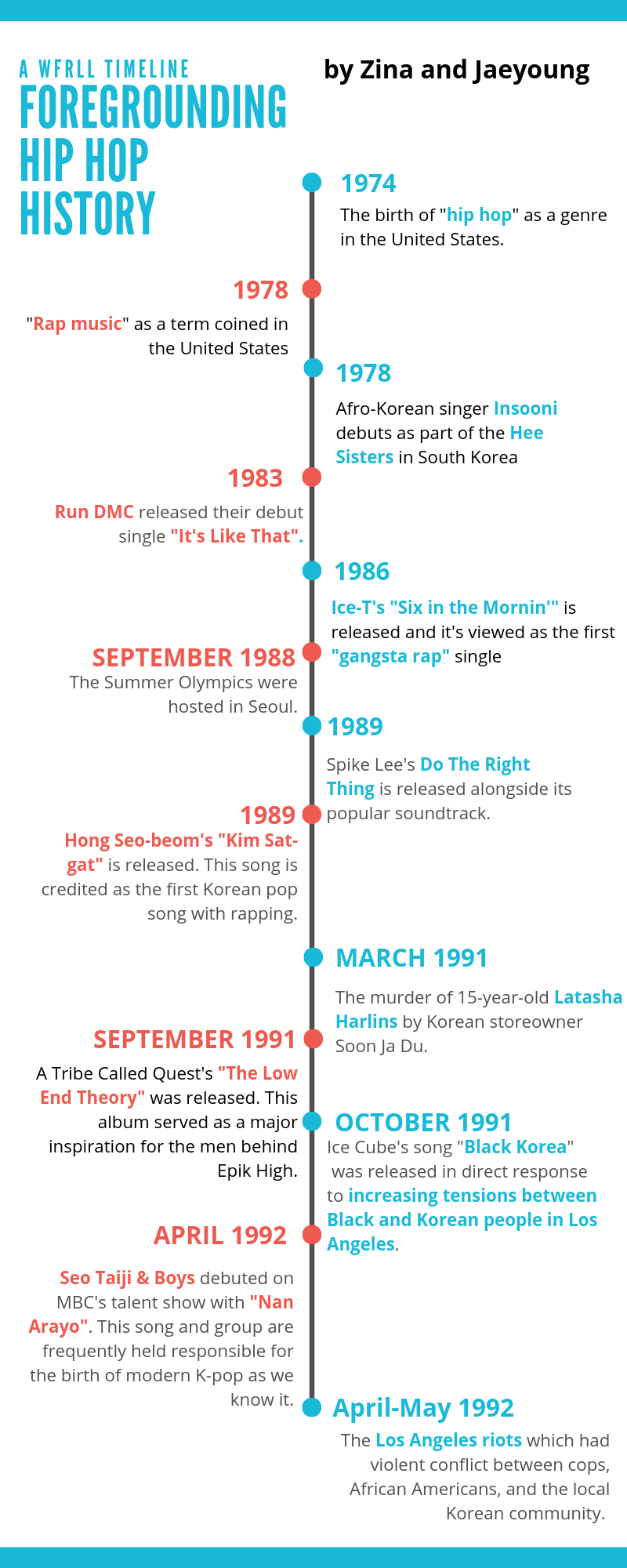
Note: This timeline is an attempt on my and Jaeyoung’s parts to show a trajectory and some major moments for hip-hop that potentially put these cultures into conversation.
As a result, timeline does not cover every single event that happened across Black and Korean hip hop history. Otherwise, it’d be book-length and I would be a hot mess from having to wade through my sources even longer.
(Please let me know if you need or want a PDF copy of this timeline and source post!)
While the foundations of hip hop music were laid in 1972/1973, multiple sources claim that the genre didn’t take flight until 1974. Further sources claim that Keith “Cowboy” Wiggins (from Grandmaster Flash and the Furious Five) actually came up with a name for the genre four years later in 1978
1978 – “Rap music” as a term coined in the United
States
This source claims that in 1978, the music industry coins “rap music” and shifts from DJs towards MCs. However the etymology of the word “rap” and the African (and African American) tradition of rhythmic speech (often) alongside beats dates back way further and we have evidence of Black artists dating back to the Sixties performing a spoken word style that they called “rap”.
Born in 1957 to a Korean mother and an African American GI, Insooni is a soulful diva that remains one of the most well-known performers in Korea. She’s a still-active singer who performed at the 2018 Winter Olympics. She’s important to mention at this point of the project because she’s also a household name and cultural icon within Korea now and a sign that Black people from Korea are known to the citizens.
Last year, I said I wasn’t going to do this again.
I made a whole thing about it.
I was going to pretend that y’all were capable of seeing a racebent character – usually played by a Black character – and not going into a frothy rage. Y’all were going to pretend that it’s not about race, but that redheads/blonds/people with freckles all deserved representation that couldn’t come from a Black person in a wig or with a stellar dye job playing them.
Abstract Black Women, Hated: Layers of Misogynoir in Fandom Spaces As fandom spaces become even more active in asking for and creating positive representation about underrepresented identities (i.e., disabled people and queer people), one notable weak spot in fandom representation politics revolves around the reception towards and portrayal of Black women in fandom. Black female […]
I know what you’re thinking: this my third or fourth “Fleeting Frustrations” post in a row to talk critically about fandom or something a particular fandom does. I know it doesn’t seem all that fleeting and well… you’re right.
Because every single time I try to settle in the squee and have fun in my fandom(s), I’m reminded that Black people and characters aren’t respected in fandom.
This latest incident?
A Black Panther post-film story that pairs M’Baku up with a white female reader and portrays the Jabari as primitive and an author who apologizes to the person who requested the story – not the Black fans rightfully offended by the racist fanwork.
If you’re online, you probably have heard about the incoming talent for SNL’s future lineup.
One new face was Bowen Yang, who’d be the first Asian performer on the show’s regular lineup in its 44 year history. Another was Shane Gillis, a comedian with a reputation for using racist jokes and other offensive statements as part of his act and in his personal conversations on his podcast.
One of the Democratic candidates for president, Andrew Y@ng – who aspires to appeal to whiteness at pretty much every step of the way – received some of Gillis’ ire as Gillis used a racial slur to refer to him earlier this year. He addressed Gillis’ racism in multiple tweets earlier this week/end.
Titans was the reason why I signed up for DC Universe in the first place way back when the platform was first announced. I’d been in the DC fandom as a fic writer and frequent shouter, so I was prepared for the worst with the show… but I wanted to watch it anyway.
For the most part, I really liked a lot of the first season. It has its issues – and, I have like three posts in-progress about it that I may finish eventually and post on here – but for the most part it’s the kind of show that I like. It’s a show made with fandom in mind, not just fans so definitely it has a lot of content that feels tailor-made for me.
So here’s the thing with the first episode of Titans‘ second season: it feels like the finale of the first one. I think that’s because… that’s what it actually was.
Some commentary on this whole thing and why these conversations are necessary:
The way Blackness is portrayed & performed across kpop is impossible to miss unless you work at being ignorant. Appropriation of Blackness – hair, slang, aesthetic, etc – is infused into the past what… 30 yrs of kpop?
I made a point of making “Cultural Appropriation” one of the main article segments in this series as I was planning it because I got sick and tired of seeing how kpop fandom at large refused to learn and listen – especially to Black fans – about why cultural appropriation hurts.
“But as Americans who shape American pop culture, African Americans’ power is incomparably greater than any non-Americans’, including Koreans’.”
A thing that came up across the research for this segment in TK Park’s quote in the above tweet and several Korean & Korean Americans scholars, performers, and fans is I’ve come across involves them assigning tons of privilege to African Americans because of their US citizenship.
Like TK Park and a ridiculously wide amount of people – especially in conversations about cultural appropriation and Korean pop/hip hop – genuinely seem to think that being Black in the US negates the fact that we live in an antiblack world where we’re oppressed endlessly.
In case you didn’t know (possibly because you’re not on the
US’ East Coast or because you’re not in the US at all), September (the peak
month for the Atlantic Hurricane season) started with Hurricane Dorian inching
its way up across the Bahamas towards Florida.
While Florida has yet to feel anything resembling its full
force, the Bahamas have been devastated due to the storm landing and then stalling
as a Category 5 and then 4 for about two days. The images of destruction from
the high winds and storm surge that I’ve seen so far are horrifying and the island
nation will be recovering from this storm for years to come. (And note that
this is just the start of peak season. There are other hurricanes just waiting
to form and the Bahamas generally gets some level of storms as the season
progresses.)
Now on to the less serious stuff: September will be shaped
by what storms we get and how much work I can get done before the storms start
forming in seriousness after September 10th. So, while my goal is to
stick as closely to my schedule and get content out when they’re supposed to be
out, hurricane season is not on my side.








 Stitch's Media Mix
You must be logged in to post a comment.