It’s impossible to miss that I’ve spent most of 2019 writing about, listening to, and talking to other people about Korean pop and hip hop music. I have spent so much time, energy, and effort talking about what is now my primary fandom and at the end of these past eight months –
I can’t say that I regret any of it.
Criticism is part of my fandom way.
I love critical conversations about fandom. I love making connections between the theories I learned in grad school and the things I love. I genuinely and truly love getting my critical little claws all over something that I’m fond of.
If you’re so inclined, you can check out my Spotify 2019 “Top Songs” playlist for what I had on repeat this year, but if you want to know the songs I played even when I was just screwing around on YouTube and what I was thinking/why I liked it, this list is for you!
I spent a lot of 2019 listening to recent Korean pop and hip-hop. That’s probably not a surprise considering what I’ve been working on across this year.
And of course, I’m still listening to Hamilton.
Title: Love U
Artist: Monsta X
What Had Me Hooked: A few weeks ago I made a tweet about how Monsta X makes “some good songs about fucking” and “Love U”, one of their newer English releases that’ll be on their upcoming Valentine’s Day release, is one of those songs. I love this song because it is so semi-subtly hornt. Are they talking about not being able to say the word “fuck” on the radio or are they talking about not being able to say “I love you” in Korean on Western radio? Who knows! It’s exciting!
If you’re in or adjacent to Korean pop culture fandom spaces and somehow thought we’d be ending 2019 without further antiblackness from idols or their fans…
a) I’m not sure how you got to that conclusion considering how bad 2019’s been
b) You were wrong.
You were wrong, and now we have another month where an idol has thoroughly proven themselves to give less than zero shits about Black people and Black fans.
Have we had a month yet where an idol hasn’t fucked up on some way? Have we had a month in 2019 that wasn’t rife with antiblackness directly revolving around Korean pop and/or hip-hop as genres or within their fandom spaces?
I’m just so pleased about how well “hood cosplay” as a term works for my needs across my project on antiblackness in the k-pop industry and its fandom spaces. I had to do a video!
Back in in the beginning of April, when I first started this project and the idea for this section started to take form, I screenshot and shared a tweet from a K-pop fan (though the group they preferred, escapes me) that said:
“I don’t know why black people are even stupid enough to like K-pop. It isn’t for you. Go listen to rap.”
Go listen to rap.
Imagine having the nerve to tell Black fans to “go listen to rap” because – in this case – you were frustrated by yet another conversation about cultural appropriation in the K-pop industry.
Imagine being that much of a walnut that you zoom on past the fact that even the cutesiest of girl groups will have something that’s attempting to be a rap line and rap breaks in their songs – specificallyso that you can tell Black people to get the hell out of “your” fandom space/genre of choice.
This is just a taste of what international fandom spaces are like for Black K-pop fans on social media. When we are even a tiny bit critical of the way our idols try to emulate our cultures, folks tell us that we need to get out of the fandom because there’s no way that we belong.
They tell us to return to rap music, the same rap music that our favorite idols and artists are listening to and performing in South Korea.
My appearance on Jinjja Cha was kind of destined to happen. I
adore Girl Davis immensely and want to be as cool as she is one day. And while
I haven’t had the chance to talk with April yet, we’re both longtime Rain and
Miyavi fans so like… we’re clearly also soulmates separated at
birth.
So, this was in the cards as a Thing That To Take Place.
Talking with Girl was an incredible experience in terms of
like… how it felt like just going out with a buddy and getting intense over
drinks. (One day, by the way, I’m going to have that experience with them. I
promise y’all that.)
Girl and I talked about a lot of different things across
our almost three-hour-long conversation. From my whole issue with that one
barbershop that was all over social media for a few days to that time I was
friends with a white supremacist in college a decade ago, nothing was really
off limits?
And I loved it.
The main question across our conversation was about finding
our thresholds as Black fans invested in these groups and this industry that
has repeatedly shown itself to be incredibly antiblack across the past twenty or
so years.
One of the things I’ve been thinking about – especially after reading and sharing Stan’d off by Claudia Williams – is how hard is is to unstan?
Even temporarily because you’re burnt out or frustrated by a member’s hood cosplay or upset at the way the performers/their companies never seem to notice antiblackness in their fandoms – but can leap to quash a dating rumor in a heartbeat.
A podcast dedicated to South Korean entertainment. Our goal is to be informative and to have an open and mature discussion about the things we love, hate, and love to hate. Most of all we want to have fun with Kpop and share that with others!
We are made up of netizens from all over the world and we gather weekly in our spare time. Sometimes we agree, sometimes we don’t, and we hope that you find yourself in each of our voices.
At the start of October, I had the honor of guesting on Not
Your Average Netizens’ episode “Chicken Noodle Soup For the K-Pop Lover’s
Soul”. In the fun and fantastic liveshow, we covered cultural appropriation
we see from idols and the antiblacknesss we see from fandom.
In both cases, we talked about “Chicken Noodle Soup”
(BTS’ J-Hope’s take on the 2006 song featuring Becky G) and the fandom’s
overwhelmingly blah and bad reaction to J-Hope’s gel twists or the art on the
single’s cover and Black fans who were annoyed at or offended because of any
aspect of the collaboration.
We also talked about how CNS is kind of exemplary of how
Black culture/creativity isn’t valuable to non-Black people until other
non-Black people partake of it and perform it. Like I’ve talked about this to a
bunch of people – and we brought it up here too – that if you’re “acting hood”
and dropping signals of Blackness in your video but you… probably have never
had a significant and intimate relationship with a Black person… how authentic is
your performance, really? Aren’t you just putting on a costume?
And why defend someone’s inauthentic portrayal of Blackness
when you’re consuming their content?
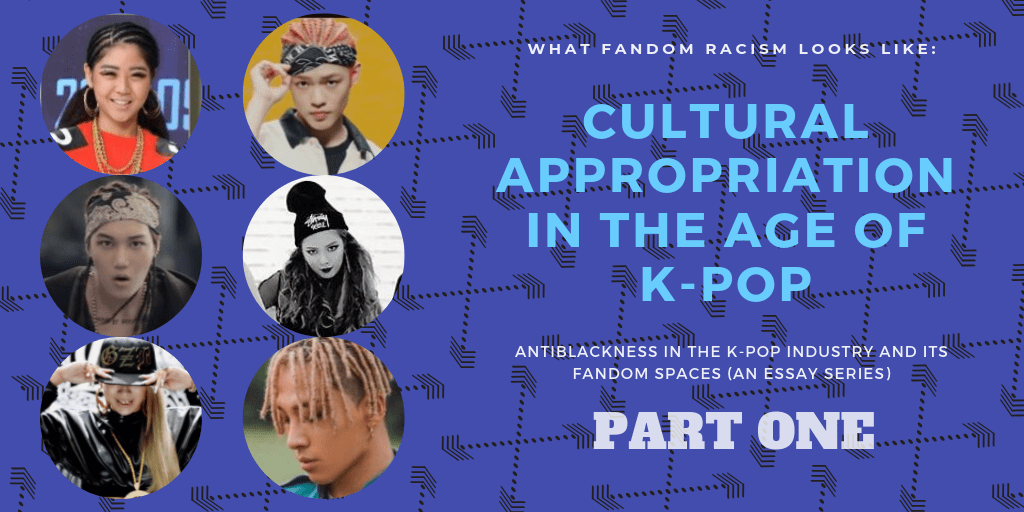
In this installment of What Fandom Racism Looks Like: Antiblackness in the K-Pop Industry and its Fandom Spaces, we’ll be doing some fast and furious foregrounding.
The point of this foregrounding essay isn’t to
provide readers with an exhaustive and complete history of Korean and/or African
American hip hop and popular music.
Here are the goals of this furious foregrounding essay:
to provide some context when it comes to what K-pop generally is for folks with a wobbly grasp
To briefly cover the history of Black creativity being exported to South Korea and beyond without Black influence (but with antiblackness),
To foreground myself and my experiences with this genre and the fandom spaces.
Let’s start with a quick coverage of what k-pop is from
two experts who’ve written books on it.
Context Matters
In the introduction to his monograph Sorting out K-Pop: Globalization
and Popular Music in South Korea, Michael Fuhr writes that:
K-Pop is mainstream music in South Korea. Initially modeled for the teenager market, this music of the country’s youth has become the most pervasive music in Korea, effectively shaping the sonic public sphere, the musical tastes among different generations, and the imaginative worlds of its consumers and producers. (3)
Then in Suk-Young Kim’s K-Pop Live: Fans, Idols, and
Multimedia Performance, she writes that:
In the broadest sense of the word K pop as an abbreviation for Korean popular music includes all genres of popular music that emerge out of South Korea. […] But in from 2009 onward, when the term entered a wide circulation, it came to designate a much smaller fraction of south Korean music. according to pop music critic Choe Ji-seon, it references “music dominated by idols dance music which strives to gain a competitive edge in the international market .in this respect indie music or rock or anything that does not belong to dominant Idol music usually is not characterized as K pop”. (8).
K-pop – as an industry and as a genre (smush), is a
multifaceted [thing] that really dates back to just under thirty years ago with
the term itself dating back to the mid-nineties. (Suk-Young Kim traces the term
to Hong Kong’s Channel 5 in 1995 and mentions that it follows in the footsepts
of the already coined and widely used “J-pop” [8]).
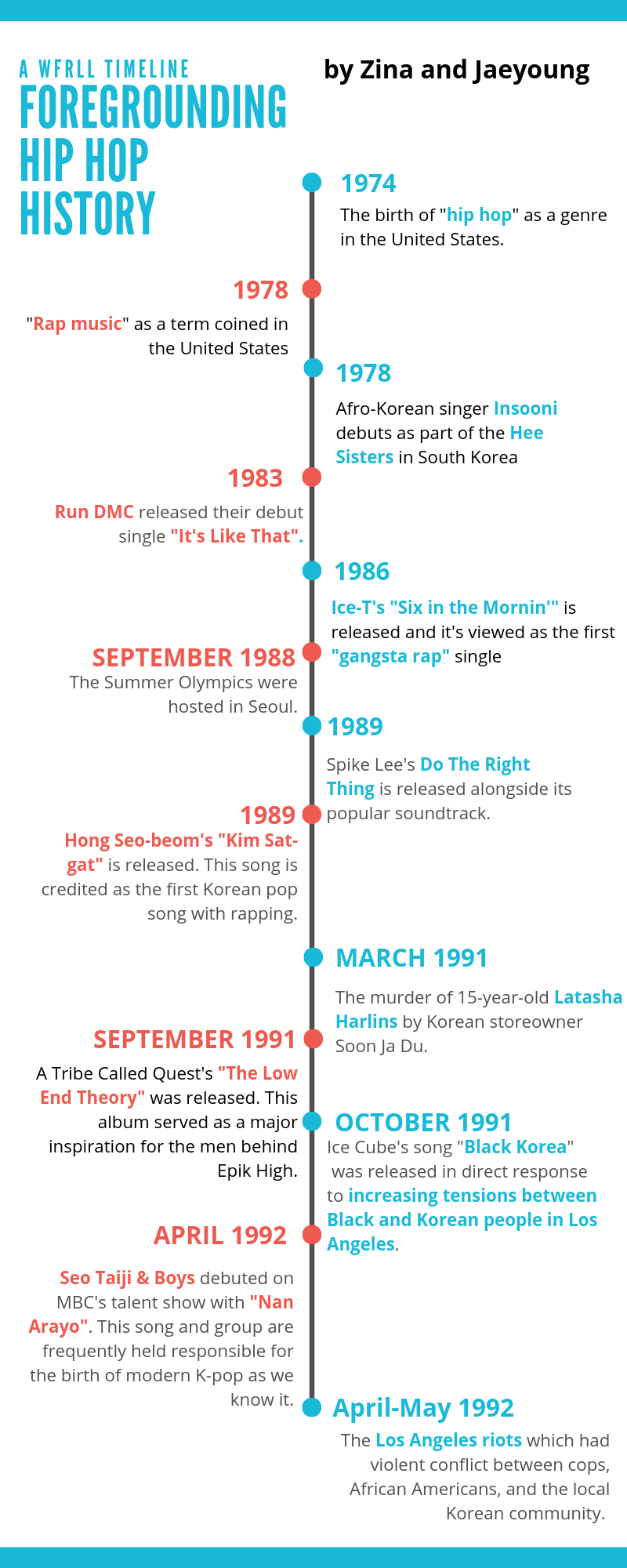
Note: This timeline is an attempt on my and Jaeyoung’s parts to show a trajectory and some major moments for hip-hop that potentially put these cultures into conversation.
As a result, timeline does not cover every single event that happened across Black and Korean hip hop history. Otherwise, it’d be book-length and I would be a hot mess from having to wade through my sources even longer.
(Please let me know if you need or want a PDF copy of this timeline and source post!)
While the foundations of hip hop music were laid in 1972/1973, multiple sources claim that the genre didn’t take flight until 1974. Further sources claim that Keith “Cowboy” Wiggins (from Grandmaster Flash and the Furious Five) actually came up with a name for the genre four years later in 1978
1978 – “Rap music” as a term coined in the United
States
This source claims that in 1978, the music industry coins “rap music” and shifts from DJs towards MCs. However the etymology of the word “rap” and the African (and African American) tradition of rhythmic speech (often) alongside beats dates back way further and we have evidence of Black artists dating back to the Sixties performing a spoken word style that they called “rap”.
Born in 1957 to a Korean mother and an African American GI, Insooni is a soulful diva that remains one of the most well-known performers in Korea. She’s a still-active singer who performed at the 2018 Winter Olympics. She’s important to mention at this point of the project because she’s also a household name and cultural icon within Korea now and a sign that Black people from Korea are known to the citizens.
Some commentary on this whole thing and why these conversations are necessary:
The way Blackness is portrayed & performed across kpop is impossible to miss unless you work at being ignorant. Appropriation of Blackness – hair, slang, aesthetic, etc – is infused into the past what… 30 yrs of kpop?
I made a point of making “Cultural Appropriation” one of the main article segments in this series as I was planning it because I got sick and tired of seeing how kpop fandom at large refused to learn and listen – especially to Black fans – about why cultural appropriation hurts.
“But as Americans who shape American pop culture, African Americans’ power is incomparably greater than any non-Americans’, including Koreans’.”
A thing that came up across the research for this segment in TK Park’s quote in the above tweet and several Korean & Korean Americans scholars, performers, and fans is I’ve come across involves them assigning tons of privilege to African Americans because of their US citizenship.
Like TK Park and a ridiculously wide amount of people – especially in conversations about cultural appropriation and Korean pop/hip hop – genuinely seem to think that being Black in the US negates the fact that we live in an antiblack world where we’re oppressed endlessly.
“The harm of cultural appropriation lies in how the people doing the appropriation of a minority group’s culture, removing it from its context, dehumanize the minority group and dismiss their concerns or humanity.”
Another issue in
how cultural appropriation of Black culture and Blackness leads people to devalue the culture and people they’re
copying: across my research for this essay series – and this installment in
particular – one thing that keeps coming up is how little people care for Black members of the fandom spaces and for
Black people in general.
One way that they
do this is in the way they talk about hip hop and rap.
How many times have you seen people talk about how they didn’t actually like hip-hop or rap until they listened to it from a Korean artist because that version of the genre was so much purer?
I see it primarily with the rappers currently in idol groups, but I don’t doubt that hip-hop artists in Korea who are outside the idol industry get hyped up in a similar way.
Rap from Black
USians is always associated with violence, poverty, grasping for unearned
power, misogyny, etc.
The image of a
rapper to Koreans and to many non-Black fans engaging with this music –
especially outside of the US – is someone closer to Fetty Wap in “Trap Queen”
or Snoop Dogg in the nineties than Jidenna in “Long Live the Chief” or Janelle
Monae and Missy Elliot in uh… anything.
Like there’s no attempt to understand that there’s diversity in hip-hop in the US, that rappers and Black people come from all walks of life and are valid because of it.
“Ideas, cultures, and histories cannot seriously be understood or studied without their force, or more precisely their configurations of power, also being studied.
Edward Said, Orientalism
“Dressing up as “another culture”, is racist, and an act of privilege. Not only does it lead to offensive, inaccurate, and stereotypical portrayals of other people’s culture … but is also an act of appropriation in which someone who does not experience that oppression is able to “play”, temporarily, an “exotic” other, without experience any of the daily discriminations faced by other cultures.”
Near the end of
January 2019, TK Park of “Ask A Korean” fame took to his site in order to talk
about the response from (primarily) Black people to the article he and Youngdae
Kim had written for New York Magazine/Vulture about
the history of Korean hip hop.
In Park’s article
“K-pop in the Age of Cultural Appropriation,”
he argues that the idea of cultural appropriation is “inapposite” to K-pop
because “K-pop is a product to imperialism by the West, and in particular the
United States”.
Park unpacks this statement across the article to some various levels of success, but essentially his goal lies in removing the very potential of/responsibility for the appropriation of Black American culture from Koreans and Korean Americans. He does this, in part, by repeatedly bringing up the aftermath of the Korean War and the long arm of US imperialism as reasons why Black people “can’t” complain. (I’m legitimately Not Kidding about this shit.)
He makes it about privilege as he scolds the (presumed Black) audience for daring to have opinions about how Black music and culture are repackaged by many Korean hip-hop and pop artists and discussed by them and their fans.
We haven’t had a ton of truly celebratory fandom-related content on here in a hot minute and that’s because my critical brain is in overdrive working on various projects.
However, one thing I’ve wanted to share with y’all across my deepening investment in K-pop and alongside the critical work I’m doing about the genre/industry and its related fandom spaces is what I flat out love about it.
So instead of the BTS World review I’d actually planned to try
and get out, I’m going to do a post looking at my favorite BTS songs and why I
love them. I’m including solo member songs (solo meaning that they’re not a
part of the EPs/CDs they put out with the group) in this and uh… you’ll be able
to tell really fast what my favorite kinds of BTS songs in terms of
arrangements/who gets the focus.
(And on the subject of BTS World: no joke, the game’s a time
and money sink and I am surprisingly not captivated by it despite my love of
dating sims on top of the frustration. And since I can’t screenshot anything since
I’ve got an Android phone – the game lets iPhone users screenshot with a
warning ugh – it’s kind of annoying.)
Anyway! Here’s a list of my most favorite BTS songs!
I’m glad I can share this sort of purely celebratory
experience with you nerds!
Outside of maybe a handful of countries around the world, there aren’t many places where I’m guaranteed to be entirely free from anti-black racism. Even my home island of St. Thomas in the US Virgin Islands isn’t a safe space for me as a Black person –
And I grew up there.
Because anti-blackness is so ubiquitous across so many different spaces and how often it shows up in situations where Black people aren’t actually present or involved, I am not surprised at anti-blackness being present out of the blue – to me at least.
I am really not surprised at how antiblackness shows up in the K-pop fandom – because antiblackness is everywhere in fandom spaces.
But there’s something a little… extra about how anti-blackness works in K-pop fandom spaces and how much of that anti-blackness is actually fueled by issues present in the music industry’s consumption and repackaging of Black culture.Read More »







 Stitch's Media Mix

You must be logged in to post a comment.