[Video] Black Women, Hated: Layers of Misogynoir in Fandom Spaces – PCA 2019

Abstract Black Women, Hated: Layers of Misogynoir in Fandom Spaces As fandom spaces become even more active in asking for and creating positive representation about underrepresented identities (i.e., disabled people and queer people), one notable weak spot in fandom representation politics revolves around the reception towards and portrayal of Black women in fandom. Black female […]

On Oppression Olympics and Black Hypervisibility

If you’re online, you probably have heard about the incoming talent for SNL’s future lineup.

One new face was Bowen Yang, who’d be the first Asian performer on the show’s regular lineup in its 44 year history. Another was Shane Gillis, a comedian with a reputation for using racist jokes and other offensive statements as part of his act and in his personal conversations on his podcast.

One of the Democratic candidates for president, Andrew Y@ng – who aspires to appeal to whiteness at pretty much every step of the way – received some of Gillis’ ire as Gillis used a racial slur to refer to him earlier this year. He addressed Gillis’ racism in multiple tweets earlier this week/end.

One part of his response to Gillis’ racism towards him and other East Asian people was to compare racism towards East Asian people and the reaction from the general population when racism happens to Black people, tweeting that, “If Shane had used the n word the treatment would likely be immediate and clear.”

The idea of anti-blackness like a minor celebrity using the n-word being met with “immediate and clear” punishment is laughable.

Read More »

[Video] Stitch Tackles TK Park’s K Pop in the Age of Cultural Appropriation

Some commentary on this whole thing and why these conversations are necessary:

The way Blackness is portrayed & performed across kpop is impossible to miss unless you work at being ignorant. Appropriation of Blackness – hair, slang, aesthetic, etc – is infused into the past what… 30 yrs of kpop?

I made a point of making “Cultural Appropriation” one of the main article segments in this series as I was planning it because I got sick and tired of seeing how kpop fandom at large refused to learn and listen – especially to Black fans – about why cultural appropriation hurts.


“But as Americans who shape American pop culture, African Americans’ power is incomparably greater than any non-Americans’, including Koreans’.”

A thing that came up across the research for this segment in TK Park’s quote in the above tweet and several Korean & Korean Americans scholars, performers, and fans is I’ve come across involves them assigning tons of privilege to African Americans because of their US citizenship.

Like TK Park and a ridiculously wide amount of people – especially in conversations about cultural appropriation and Korean pop/hip hop – genuinely seem to think that being Black in the US negates the fact that we live in an antiblack world where we’re oppressed endlessly.

Read More »

[Video] The Cultural Appropriation Conversation: So Very Hairy

“The harm of cultural appropriation lies in how the people doing the appropriation of a minority group’s culture, removing it from its context, dehumanize the minority group and dismiss their concerns or humanity.”

Cultural Appropriation in the Age of K-Pop
Part One: https://stitchmediamix.com/?p=8351
Part Two: https://stitchmediamix.com/?p=8361

Links
Sundai Love: https://www.youtube.com/watch?v=8IFFkexNZOQ
Melanated Butterfly: https://melanatedbutterfly.com/being-black-in-south-korea/
Different in Korea: https://differentinkorea.wordpress.com/

Cultural Appropriation in the Age of K-Pop Part Two

Did you read Part One?


Another issue in how cultural appropriation of Black culture and Blackness leads people to devalue the culture and people they’re copying: across my research for this essay series – and this installment in particular – one thing that keeps coming up is how little people care for Black members of the fandom spaces and for Black people in general.

One way that they do this is in the way they talk about hip hop and rap.

How many times have you seen people talk about how they didn’t actually like hip-hop or rap until they listened to it from a Korean artist because that version of the genre was so much purer?

I see it primarily with the rappers currently in idol groups, but I don’t doubt that hip-hop artists in Korea who are outside the idol industry get hyped up in a similar way.

Rap from Black USians is always associated with violence, poverty, grasping for unearned power, misogyny, etc.

The image of a rapper to Koreans and to many non-Black fans engaging with this music – especially outside of the US – is someone closer to Fetty Wap in “Trap Queen” or Snoop Dogg in the nineties than Jidenna in “Long Live the Chief” or Janelle Monae and Missy Elliot in uh… anything.

Like there’s no attempt to understand that there’s diversity in hip-hop in the US, that rappers and Black people come from all walks of life and are valid because of it.

Read More »

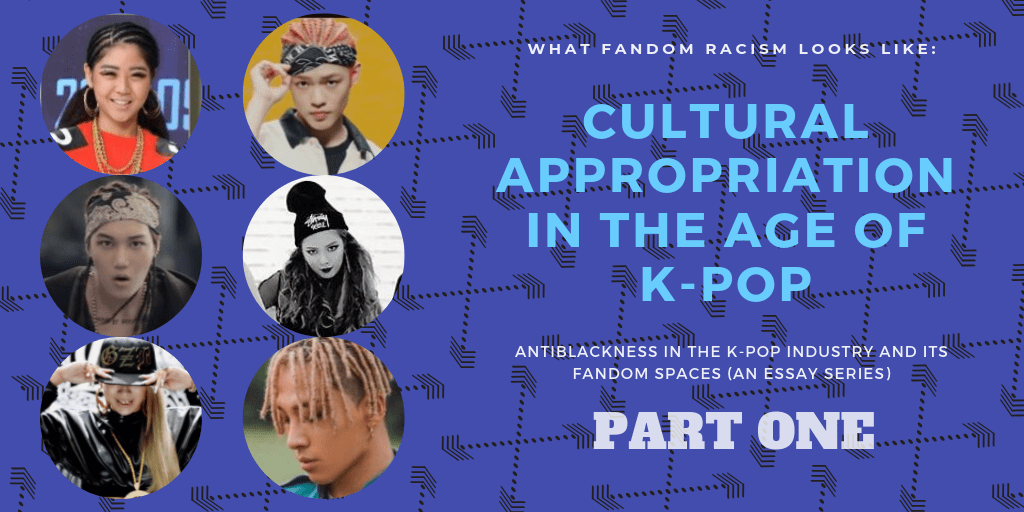
Cultural Appropriation in the Age of K-Pop Part One

“Ideas, cultures, and histories cannot seriously be understood or studied without their force, or more precisely their configurations of power, also being studied.

Edward Said, Orientalism

“Dressing up as “another culture”, is racist, and an act of privilege. Not only does it lead to offensive, inaccurate, and stereotypical portrayals of other people’s culture … but is also an act of appropriation in which someone who does not experience that oppression is able to “play”, temporarily, an “exotic” other, without experience any of the daily discriminations faced by other cultures.”

Kjerstin, Johnson, “Don’t Mess Up When You Dress Up: Cultural Appropriation and Costumes

Near the end of January 2019, TK Park of “Ask A Korean” fame took to his site in order to talk about the response from (primarily) Black people to the article he and Youngdae Kim had written for New York Magazine/Vulture about the history of Korean hip hop.

In Park’s article “K-pop in the Age of Cultural Appropriation,” he argues that the idea of cultural appropriation is “inapposite” to K-pop because “K-pop is a product to imperialism by the West, and in particular the United States”.

Park unpacks this statement across the article to some various levels of success, but essentially his goal lies in removing the very potential of/responsibility for the appropriation of Black American culture from Koreans and Korean Americans. He does this, in part, by repeatedly bringing up the aftermath of the Korean War and the long arm of US imperialism as reasons why Black people “can’t” complain. (I’m legitimately Not Kidding about this shit.)

He makes it about privilege as he scolds the (presumed Black) audience for daring to have opinions about how Black music and culture are repackaged by many Korean hip-hop and pop artists and discussed by them and their fans.

Read More »

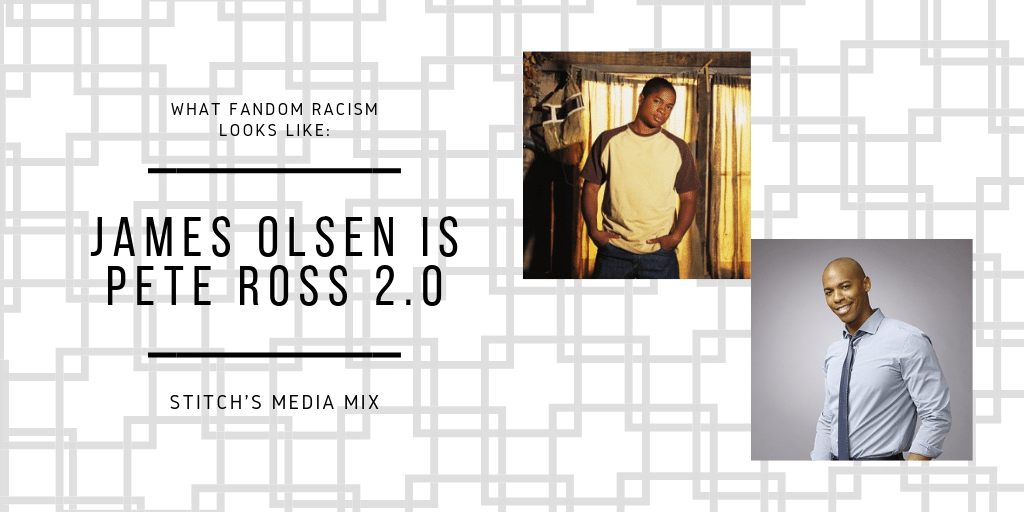
What Fandom Racism Looks Like: James Olsen is Pete Ross 2.0

I’ve talked a ton about what fandom spaces look like when Black woman steps into a racebent role, but not about what happens to Black men who play racebent roles in the same franchises.

If you think that things are any easier for Black men in fandom well…

You’ve thought wrong.

This installment of What Fandom Racism Looks Like will look at how the racism behind how the Smallville fandom treated Pete Ross – played by Sam Jones III – and how, over a decade later, the Supergirl fandom pulls from the same playbook in order to excuse heaping a ton of racism on James Olsen and the black actor that plays him, Mehcad Brooks.

Read More »

Antiblackness in the K-pop Industry and its Fandom Spaces: Introduction

WFRLL - K-Pop - Intro Header - A (1).png

Anti-blackness is universal.

Outside of maybe a handful of countries around the world, there aren’t many places where I’m guaranteed to be entirely free from anti-black racism. Even my home island of St. Thomas in the US Virgin Islands isn’t a safe space for me as a Black person –

And I grew up there.

Because anti-blackness is so ubiquitous across so many different spaces and how often it shows up in situations where Black people aren’t actually present or involved, I am not surprised at anti-blackness being present out of the blue – to me at least.

I am really not surprised at how antiblackness shows up in the K-pop fandom – because antiblackness is everywhere in fandom spaces.

But there’s something a little… extra about how anti-blackness works in K-pop fandom spaces and how much of that anti-blackness is actually fueled by issues present in the music industry’s consumption and repackaging of Black culture.Read More »

[Pitch The Stitch] What Fandom Racism Looks Like: Antiblackness in K-Pop Fandom and Industry

Pitch the stitch - kpop fandom and industry antiblackness

In case you’ve missed it, I’m doing a project for my website on anti-Blackness in K-pop fandom spaces and why the industry’s understanding and appropriation of Blackness/Black culture for the aesthetics of it all partially fuel the problem.

It’s already a massive project, but I want to make even more work for myself by opening up for guest posts related to the series I mentioned writing over on Patreon.

While of course, anyone can send me a pitch and I’m open to anything, I want to center the voices of other Black fans and Korean fans across their diaspora who’ve talked about the genre/industry’s relationship with (anti?) Blackness across this project.

If you’re interested in doing a guest post at any point in this project – about your relationship with K-pop as a Black fan or how you engage with the reality of the fandom or industry’s anti-Blackness as a Black and/or Korean person in these spaces – here’s your chance. I’d like to open up my platform and my site to you!

I’m looking for:

  • 5 guest posts (for the time being, i’d eventually like to post as many as 10 essays/guest posts)
  • 600-1000 words each (i won’t say no to longer posts, but I feel like that works best for what I can pay)
  • posts can be celebratory OR critical when it comes to talking about your experiences as fans

While I can’t pay a ton because I’m poor and money’s tight, THESE ARE FOR PAID GUEST POSTS @ $40 a post!

This is my first attempt at doing this kind of organized guest post set-up so please, don’t let this flop!

🙂

You can find the Google form here.

Fleeting Frustrations #3: When White Queer Icons Like Ezra Miller Fail Us

Seeing Ezra Miller’s face everywhere makes me feel some kind of way.

On one hand, I’m constantly charmed by Miller and I like that they’re a queer icon (who just apparently came out as non-binary). Their Playboy photos are pretty (so pretty) and I really do like knowing that one more performer in a superhero film is queer.

On the other hand, I’m always painfully aware of the fact thatnot only did Miller co-direct TheTruth According to Darren Wilson (a film intending to sympathize withand see the other side of events that led to Mike Brown’s senseless murder),but that it’s not a hard limit for many of the queer non-Black people that findout about it.

At the end of the day, it stings to realize that to many people, Miller’s queerness is seen as more important to talk about than the casual racism behind Miller working on a film that exists to humanize a racist murderer.

Read More »

What Fandom Racism Looks Like: The Smartest Girl in the World Has To Be A Mary Sue

Fandom Racism - Mary Sue

On the first day of Black History Month, a random writer on Archive of Our Own gave to me… two separate stories that framed Shuri – T’challa’s brilliant baby sister in Black Panther –  as a character that couldn’t possibly be as smart as the MCU claims and as a victim of child abuse by the Wakandan elite who are “taking advantage” of her brilliance.

These stories were written in response to Black people calling out the author’s racism in deeming Shuri a Mary Sue in Black Panther in a tumblr post (that used the Black Panther tag) and subsequently writing off the film.Read More »

Let Black People Feel Things in Fandom 2018

LET BLACK PEOPLE FEEL THINGS IN FANDOM 2018

In 2016, I made a list of things that I wanted to see fandom leave behind as we moved into the next year.

Fandom left absolutely NONE of those things behind in 2017.

I’m not going to talk about the stalking, the increase in harassment, the doubling down on the claim that Armitage-fucking-Hux being a more interesting character than Finn or Poe Dameron are in the Star Wars fandom. No, I’ll save those hot takes for another day when I don’t feel quite so much like doing a salt-and-burn on several fandom spaces which have crossed boundaries I didn’t know existed.

For now, I’m going to talk about how fandom is incapable of letting Black people – real Black people and the Black characters we love – feel things without rushing to delegitimize those feelings.

border

To a significant chunk of the Star Wars fandom, Finn is a traitor and a coward for turning against the fascist organization that stole him from his family and brainwashed him.

The Flash’s Iris West is supposedly spoiled because she made a private comment about her frustration at having her friends disrupt their wedding celebration and ignore their wishes/needs.Read More »

[Flashback Friday] Dear Fandom, It’s Always About Race

I originally wrote this post over a year ago, back in May 2016. It was one of those period where I was seeing racism in fandom surge to a high level (this was after the meta of doom a certain BNF wrote) and I was just so fed up by how many people were dismissing our conversations about race and racism in fandom and saying “it’s not about race”.

So, I wrote an open letter that is sadly still relevant in fandom to this day.


Dear Fandom

Dear fandom,

It is ALWAYS about race.

No matter how you twist it, fandom’s collective and constant dislike of characters of color (especially if they’re in relationships/shippes with white male characters) for some reason you “just can’t put your finger on” is directly related to race.

Your race.

Their race.

Race.Read More »

Fandom Racism: Predictable AF

Fandom is nothing if not predictable.

I know I’m late, but I just saw the casting announcements for the upcoming Netflix/BBC series Troy: Fall of a City. One thing that immediately stood out to me was the way that the casting immediately flipped the script when it came to Achilles and Patroclus, casting two dark skinned Black actors in the roles.

I was (am still) excited by the choice to cast David Gyasi as Achilles and Lemogang Tsipa as Patroclus because it’s an inspired casting choice. Nothing about this story of gods and messy humans has whiteness inherent to the casting and I think it’s time that we got some dark-skinned people in these period pieces who weren’t slaves…

However, I know fandom.

I’m in fandom.

I know what the response will be from people who make a point of claiming objectivity and fighting against “blackwashing” with no sense of self-awareness even as they plaster #BlackLivesMatter and don a cloak of perfect progressivism. I can predict fandom racism and the forms it will take without even trying (and definitely without wanting to) because it’s a repeating pattern that fandom can’t let go of.Read More »

“Fandom is supposed to be fun.”

#makefandomfunagain

Some variation on the phrase “fandom is supposed to be fun” gets spouted like clockwork every single time that people of color in fandom try to talk about the way that fan spaces – predominantly slash fandom spaces – are frequently inhospitable to fans of color seeking more representation in their fan communities and downright disrespectful to characters of color in these slash-heavy fandoms.

Try talking about the way that characters of color are treated across the board in slash-filled fandom spaces sometime.

Try pointing out that while you like slash and have ID’d as a slasher for well over half of your life, sometimes it’d just be nice if characters that look like you weren’t either ignored or portrayed via racist stereotypes in slash fandom.

Try tagging any commentary that even remotely attempts to be critical of the reasons behind why fandom ships the ships they do.

Try it.

I dare you.

Watch how quickly a space that keeps being touted as a safe one for women quickly becomes unsafe. Watch how quickly your fellow fans treat you like an outsider and ignore any validity in your words because people like you are taking the fun out of fandom.

I agree with the basic sentiment, that fandom is supposed to be fun.

But I just wish that it actually was fun.

For everyone.

As a result of things I’ve seen and experiences I’ve had, I always find myself wondering: who’s fandom supposed to be fun for and why isn’t it fun for everyone?

Even the chilliest of observations of fandom that count as “fandom critical” are frequently met with rude and violent comments in our inboxes, snark from other people of color who just want to fit in, and people talking smack like it’s something they’re getting paid to do.

To point out that there is racism in fandom and that fandom does need to try a little harder to make its spaces more welcoming to people of color of all kinds is to wind up subjected to dehumanization from your fellow fans because the first rule of fandom apparently is “don’t mess up anyone’s fun or else”.

Why is it that our fellow fans constantly rant and rave about how they long for the “good ole days” of fandom and strive to #makefandomfunagain with some of the same dehumanizing tactics and language that certain political figures have used to refer to people of color and anti-racist activists offline.

Why is it that our fellow fans have decided that the main thing that makes fandom “un-fun” is other people being critical of it in any way?

Oh! And if you’re wondering what constitutes “un-fun” in fandom well… here’s a checklist for you:

  • Talking about race in fandom? Un-fun.
  • Talking about racism in fandom? Un-fun.
  • Pointing out that slash fandom spaces/fans constantly center white dudes? Un-fun.
  • Writing about characters of color with fandom’s favorite white dude? Un-fun.
  • Being vocally and visibly both a person of color and socially aware (or “woke”) in fandom? Un-fun.

Essentially, if you’re a person of color in fandom spaces (any kind of fandom space, true, but primarily slash-filled fandom spaces), by asking your fellow fans to respect and acknowledge what it means to be a person of color in fandom and what it means to like characters of color in fandom, you’re not fun…

And you apparently don’t deserve to have any fun in fandom as a result.