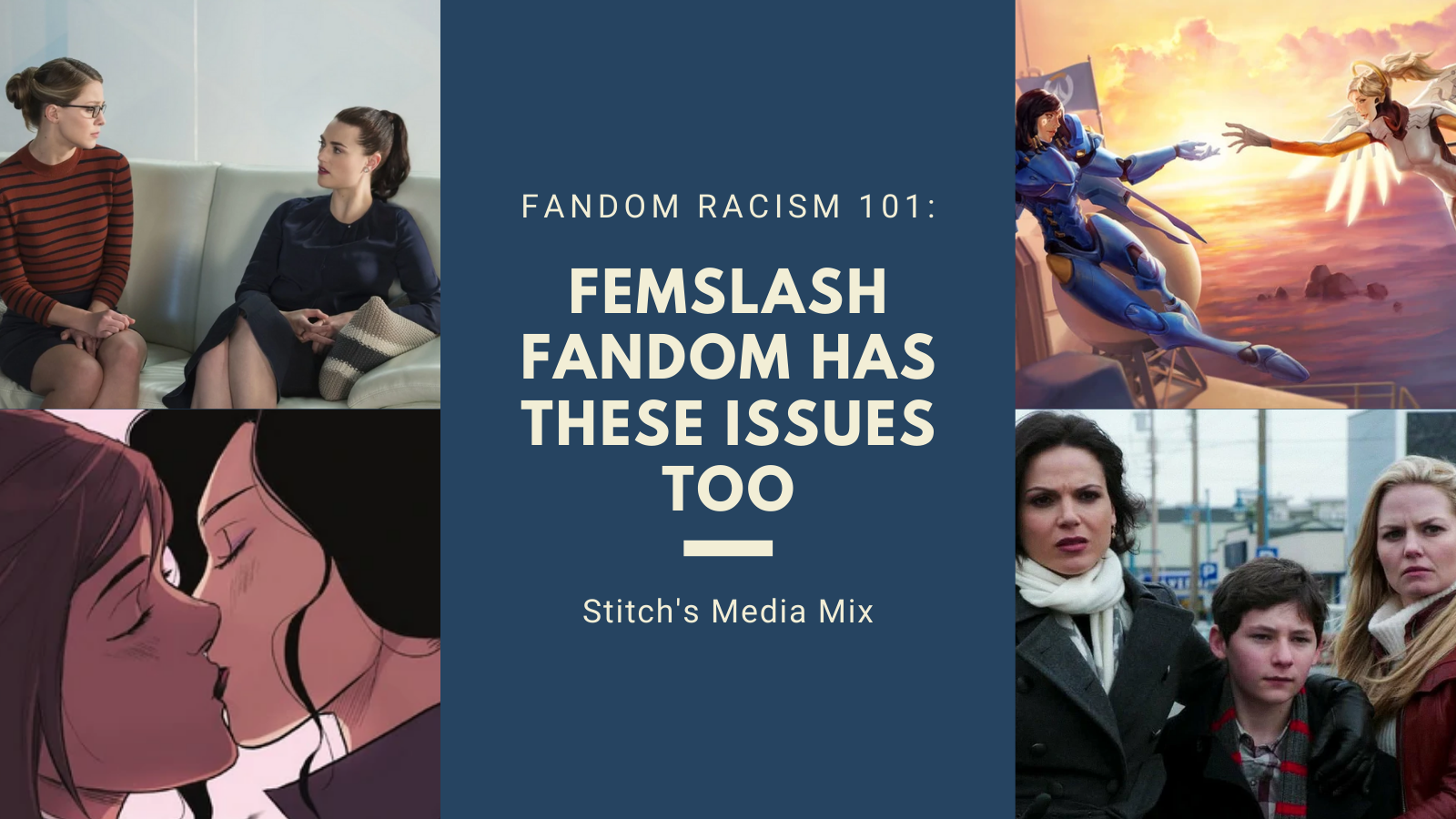
Fandom Racism 101: Femslash Fandom Has These Issues Too

It is also interesting to note that Glee debuted in 2009, the same year as RaceFail ’09. In many ways, this event, though not engaged with at the same level in all fandom spaces, marked a watershed in the ways in which debates around these issues were framed. While fans who point out the overwhelming whiteness and US-centrism of fan spaces and texts still face backlash, there has been a definite shift in the ways these categories are approached.

“Yes, the Evil Queen is Latina!”: Racial dynamics of online femslash fandoms” by Dr. Rukmini Pande and Swati Moitra

I have written a lot about M/M and “dudeslash” fandom practices over my time of thinking critically in fandom because that was, for a very long time, the loudest part of the fandoms I was in, and adjacent to, and the thing I wrote the most as a fan creator. However, that may give the impression that femslash and F/F fandoms do not have the same issues that wider fandom spaces do and that would be incredibly incorrect.

For this Fandom Racism 101 installment, we’ll be talking about how femslash fandoms also suffer from some of the same issues that other fandom spaces do. We’ll also cover some reasons why more people don’t know that femslash has these issues, how we can clock racism in femslash in its most obvious forms, and some examples of how these fandoms fail… alongside ways they can be better about their practices.

Read More »

Quick Coverage: ENGENES… A New and Surprisingly Antiblack Idol Fandom

I’ve been keeping up with what’s been going on with ENGENES (the fandom for BE:Lift’s flagship boy group Enhypen) for a hot minute. The most concise description of what is ongoing is here at @ENbackup on Twitter, the first three tweets in a thread detailing the issue with one member of the group and multiple members of the fandom on Twitter and fandom platform Weverse:

On 25th June 2021, the video [EN-CORE] ‘BORDER CARNIVAL’ MUSIC SHOW BEHIND EP.4 was released on ENHYPEN’s YouTube channel. At the 10:50 mark, a member is heard saying a racial slur. This has caused disappointment, offense and shock amongst ENHYPEN’s international fanbase.

ENGENE has demanded a statement from BELIFT, ENHYPEN’s label to clarify this situation. However, BELIFT does not have a public email address for fans to contact them in case of such situations. This neglect has forced fans to take to social media to voice their concerns.

Concequently, BELIFT continued failure to act has exposed ENGENE to harassment, slurs, death threats and violent images on all social media. Posts and hashtags demanding for the label’s actions have been suppressed on Weverse while vile racism roams on the feed unsupervised:

@ENbackup goes on to showcase several examples of extreme antiblack racism on fandom platform Weverse in that thread:fw

Read More »

Stitch @ Teen Vogue – Two Pieces!

D&D Renaissance Could Usher in More Accessibility, Inclusivity in TTRPG Fandom

Tabletop RPG games have always brought people together through collaborative storytelling and the way that players work in groups to defeat bosses. Prior to 2020, they were a way for people to connect with each other and have fun, whether it was as part of an active campaign with local friends or by joining the fandom for a streaming show hosted by celebrities. With the ongoing COVID-19 pandemic, how we engage with these games and the fandoms for long-running campaigns has shifted to accommodate the ways that the world has changed, and how we’ve changed as a result. This means that many people are seeing and challenging how these fandoms and canons work for the first time, with streamers, podcasters, and a newer generation of fans coming together to make these spaces more accessible than they were in the past.

Black TikTokers Stand Against Dance Theft in Refusal to Choreo “Thot Shit”

So much of global pop culture couldn’t exist without the contributions of Black Americans — especially TikTok, where some Black TikTokers took a stand this week by refusing to make dances to Megan Thee Stallion’s new song “Thot Sh*t.”

From streetwear trends to most of modern music, Black Americans are responsible for the development of what people across the world think of when it comes to pop culture. However, Black creators are often left behind once trends pick up speed; non-Black creators – especially young, white people – get the credit and media attention for things they didn’t create.

Normally, I’d write a whole huge thing about backstory and what inspired me in my work! However, I’m about to go start my little slice of weekend early (I have work to do tomorrow I think) and do some self care in the form of MOST OF THE FAST AND THE FURIOUS MOVIES.

So for now, I leave you with my gratitude.

I would like to thank Join The Party’s Eric Silver and Amanda McLoughlin for speaking with me for the D&D article – I learned so much from them and our conversation was delightful. Then, I would like to thank Dr. Matthew D. Morrison and Erick Louis for their insight in the TikTok piece. Their contributions were incredibly valuable for laying out the situation and I am honored to have cited them/their words in my piece.

Thank you all for reading, sharing, and engaging in good faith with my work. Please keep at it!!

July’s gonna have more good stuff too! I hope you’re excited!

Meme-Ing For A Reason #9 – Spare Some Oppression, Please?

A screenshot from the Disney Robin Hood film with the disguised titular character representing “people in fandom with ‘problematic’ ships” and the text at the bottom, implied to be speech from him, saying “May I please have a spare crumb of oppression?”

It is incredibly strange seeing people say things like “TERFs and queerphobes hate [a specific subset of shippers] the most” and frame themselves as oppressed minority any/everywhere because of what they enjoy writing, reading, and thinking about in fandom.

Not in the context of “consuming and creating queer content that shows nuanced, positive, and/or erotic relationships and dynamics triggers bigots” but just… because they are into consuming and defending supposedly problematic content that happens to be be queer and/or consumed by queer fans at all. (Like comparing the people against them or merely critical of the thing on their own time and at any level to TERFS, Nazis or the people behind the Comics Code, even when, in many cases… they’re actually talking about other queer people who aren’t even talking to/about them when talking about their issues with something in fandom.)

Read More »

DNA Remix MV + Jay Park’s Response to Criticism

Initially, I was just going to write like a TINY amount on the actual video for the DNA Remix that H1GHR just dropped for my Music Video Anatomy series on my site. But then Jay Park dropped that whopper of an essay in the comments for the video and I just… I had to do it to him. I had to make a video. Like my video pushing back at the content in the DKDKTV “bros drink soju and talk about BLM” video, this is just me airing my frustrations with a constant form of antiblackness I see. In this case, the way that Jay Park specifically talks down to Black Americans who express frustration with his persistent hood cosplay.

You can check out the entire project this is ultimately A Part Of here: https://stitchmediamix.com/nonficpost/wfrll-kpop/

Read More »

[Stitch Talks Ish] Season 2/Episode 3: Stitch Talks… with Jeanne… About Loki

CONTENT NOTES

This episode obviously has spoilers for the first episode of Marvel and Disney+’s Loki. We also speculate about the future of the show and its arcs/plots in a way that may prove to become spoilers if we’re as accurate as we want to be. Additionally, we talk candidly and cheerfully about villains, what they do, and why we connect with them (in the specific and general sense). While we don’t talk about anything in specifics – I feel – we do brush over cannibalism, The Authority’s fascism, and all the dreadful things in the plot of the 1999 film Titus. We also talk about our experiences in fandom over the years. Use your own best judgment, babes.

Read More »

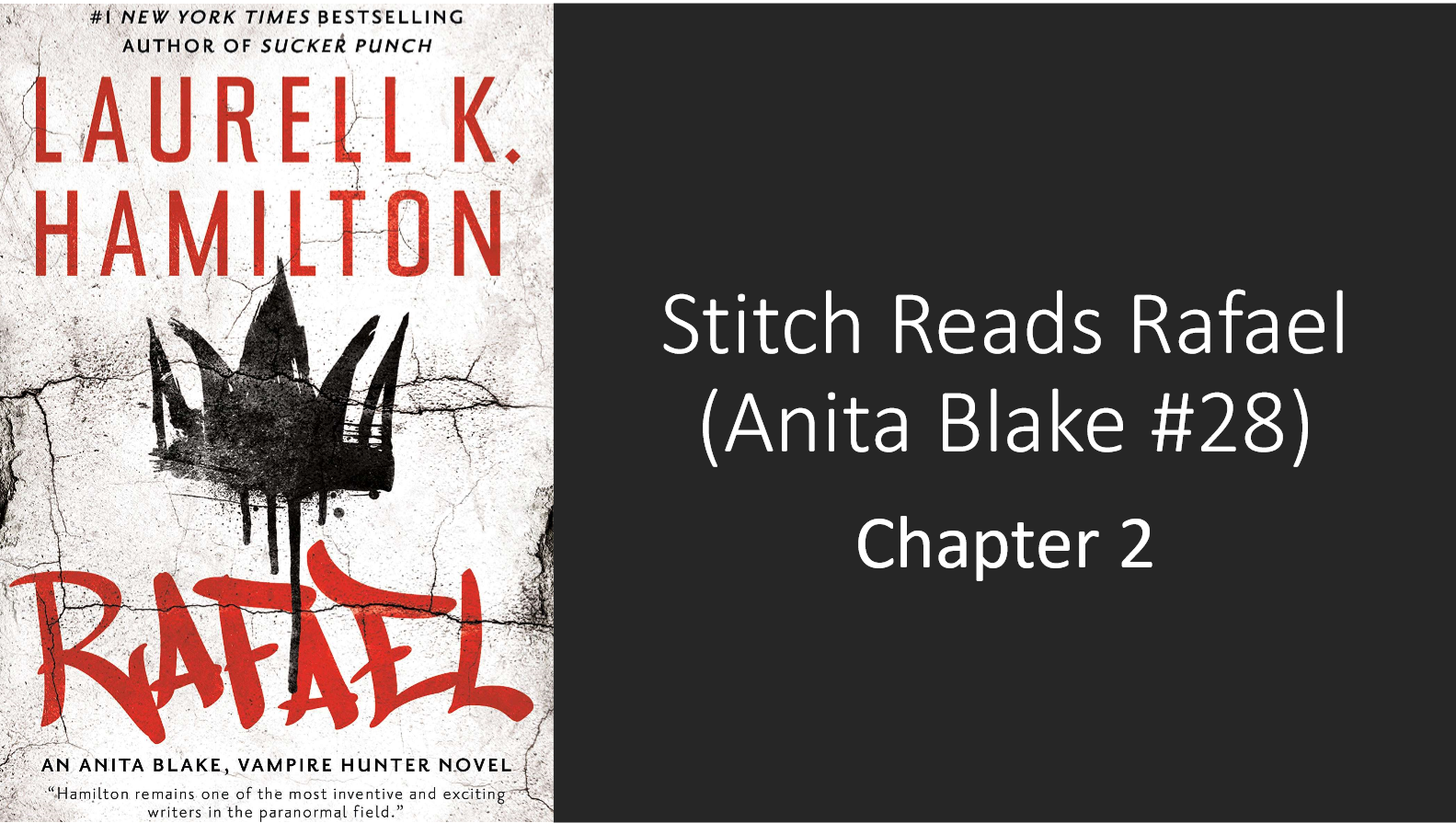
Stitch Reads Rafael (Anita Blake #28)- Chapter 2

We’re back at Rafael, beloveds, and I just… please tell me you see what I’m seeing when Rafael and his bodyguard are first introduced on the page after Anita escapes the bitch-off with Kane:

I was more bothered by Kane than I’d thought, since I didn’t sense Rafael’s energy with his main bodyguard, Benito, right beside him. Even without the otherworldly energy they were both tall: dark, muscled, and handsome for Rafael, more sinister for Benito. They both had short black hair and brown eyes, but Benito had deep facial scarring from something that looked like more than acne, but it wasn’t just the scars. I had other people in my life who had facial scars, and none of them seemed like a villainous henchman in a superhero movie, but Benito did. Maybe it was the fact that he worked so hard being scary as Rafael’s main bodyguard.

Like –

Y’all see this too right?

Like the sheer racist cringe on display here? It’s not as bad as the first time that we see Rafael introduced by how gosh darned Mexican he is, but it’s not actually that far off if you’re a recurring reader of the Anitaverse and can clock that this is basically just that? The bonus of Benito being described as menacing because of disfiguremesia – a brilliant term coined by my dear friend Mikaela a few years back – and because he’s Mexican… It just makes me itch.

Read More »

Stitch @ Teen Vogue: LGBTQ+ Fans: We’re Here, Queer, and Remaking Fandom in Our Own Image

Fandom is incredibly queer. Its origins as a space for LGBTQ+ people are well-documented, and we see that today, too. Fandom is often an online-offline queer community, supporting fans who may or may not see themselves in actual source material, but who can gather together and feel seen by each other.

This month, we’re celebrating Pride by talking about queer histories and communities within different, largely English-language, fandoms and how these spaces have allowed us to be ourselves on main in a major way. 

The first of June’s two Fan Service columns is a celebration of queer fandom. If you have somehow missed it before: I am queer.

What that means is always complex to explain because queerness is hard to define and I love being indefinable. But I’ve been here and queer for a hot minute and fandom is one of the things that helped me understand and express what I was experiencing. (It’s also where I got my first girlfriend about a decade ago! Shout out to M, who deserves The World Forever, and who first liked my Batman fic and then really liked me!)

I wanted to write this piece to celebrate one of the best things about online fandoms: that this is a great space for queer fans to figure out who we are and to build communities/relationship. Even if you don’t actually use that label for yourself – I do, obviously, but you can mentally replace it with something else that works better for you – you’re still part of something amazing and I wanted you all to know that you are loved. We’re moving along the path paved by an incredible legacy of older queer fans that I am proud to claim and be a part of. I’m truly happy that I can be in these fandom spaces with y’all.

Happy Pride, Pumpkins!

If you in the mood to get goopy, head on over to Teen Vogue for “LGBTQ+ Fans: We’re Here, Queer, and Remaking Fandom in Our Own Image” and don’t forget to share the link on your own social media if you’re interested!

Link Lineup June 2021

Finding Queer Asian America in the Margins

When I began the research for Last Night at the Telegraph Club in earnest, I knew that I needed to know more about those lesbians of color. More specifically, I needed to know what it was like to be a Chinese American lesbian in San Francisco in the 1950s, but they were nearly invisible in the historical record. The few times I came across references to Asian American lesbians, they were mentioned in passing or relegated to the footnotes.

It was enough to make one think that queer Asian Americans didn’t exist back then, but I knew that wasn’t true. What has happened is that our experiences have been erased or marginalized, deemed less important than the experiences of white LGBTQ people.

If you’re like me and you like learning more about queer histories of color, please check out this piece and get hyped for some awesome histories that you probably didn’t know before! 

Read More »

Let’s Talk About Tone Policing and (A Lack of) Reading Comprehension In Conversations About Racism In Fandom

In the sidebar for my website, I have the following block of text and a link to a resource on Adult Literacy:

Struggling with selective reading comprehension issues and think I’ve said something I clearly haven’t? Use this resource to brush up on your lackluster reading comprehension skills and consider leaving me out of your journey!

It is a snarky note, for sure, but this response to that block of text (from a Dreamwidth user who was responding to someone else who’d shared What Fandom Racism Looks Like: White Silence/Violence is really fucking out of pocket and nonsensical:

Read More »

Meme-Ing For A Reason #8 – Hello, CIA? I’d Like To Report Some Anti-Racism In Fandom, Thanks

The top right of the meme has (not Voltaire) saying “I disapprove of what you say, but will support and profit from your right to say it.”. He represents “people in different fandoms reacting to bigoted fan content and/or fans”. On the bottom right is a Karen who called the cops on Black folks barbecuing with text that says “Hello, CIA?”. She represents “people in different fandoms reacting to Black fans applying anti-racism and critical race theory to fandom”.

I am always very fascinated by how many of the people online who claim to be “radically anti censorship” and who appear to be very strong advocates for freedom of speech also… actively work to silence other people and censor them. 

Most often, as we’ve seen lately, via constant and successful attempts at silencing Black and brown people who write and teach about anti-racism in any space they (these white anti-censorship advocates) consider their own.

As I said in What Fandom Racism Looks Like: White Silence/Violence, I make a point of connecting things in the world we live in offline with fandom. 

This is no different. 

Read More »

What Fandom Racism Looks Like: White Silence/Violence

I’d known that I wouldn’t be able to depend on others to defend me regularly from a series of traumatic offline events – some of which did involve racism/antiblackness in my local friend group – back when I was a teenager. 

So, in 2011, when I first experienced social shunning and harassment because I was a Black fan criticizing fandom – at the time, not even about racism, but about a BNF’s hypocritical hater stance on NSFW fanfiction – I kind of expected more of the same. I was not disappointed.

Fast forward to 2021 and now, I’m mad as hell about the fact that people will choose to be silent in the face of racism in fandom and watch as Black/brown fans are hurt and harassed for speaking up.

Read More »

What A May… What a May…

May was such a freaking busy month for me. But beyond that, it was also just a very big career boost for me in terms of who I got to talk to and how widely my work was shared and read! 

Last month, I got to talk to… a lot of very cool people. I didn’t just get to talk to a bunch of other Black women and femme k-pop fans for my PCA 2021 project (which I’ll be presenting Friday and making public Monday/Tuesday on YouTube), I also got to talk to celebrities!

For KultScene, I interviewed rapper pH-1 over email and he did an excellent job of answering my questions. I loved learning about the creative process, how he writes for his different audiences, and where he’s heading next. 

Read More »

Stitch @ Teen Vogue: Kelly Marie Tran on “Raya,” Internet Harassment, and Fandom

Raya’s key traits are present in Kelly, too, even though the context is different. Kelly, who has faced more than her fair share of trolls and racist critics, is an actor who continues to push forward in the face of adversity and negativity. While she’s gotten to see the positive impact of her presence in these films and how a new generation of usually underrepresented fans have embraced her, she’s also been subject to a long and very public harassment campaign from a certain faction of the Star Wars fandom.

Who’s got two thumbs and interviewed Kelly Marie Tran just in time for Raya’s home release and as a very fitting end to this year’s API Month?

THIS STITCH!

Stitch @ Teen Vogue: “iCarly” Fan Misogynoir is Part of a Larger Fandom Pattern

Mosley isn’t the first to be harassed because people in a given fandom assumed she was replacing a white actress (Javicia Leslie’s Ryan Wilder on Batwoman) or because she was playing a racebent version of a “historically white” character (Anna Diop’s Starfire on Titans). And she won’t be the last, because fandom is not a space that protects Black women from misogynoir. Misogynoir, a form of anti-Black misogyny present in the ways that Black women and femmes are rewritten and dehumanized in order to excuse the way we are treated (no matter how much power we have), is alive and well in fandom spaces across the internet.

I write a lot about misogynoir in fandom. It’s something i feel strongly about because of how much it affects a wide range of fans in fandom, Black women and femmes who aren’t seen as part of these spaces. Fan entitlement is huge and we know that aggressive fans truly don’t know an end to their nonsense… but there’s a very specific way that these fans will attack Black women (fans, celebs, and journalists) that needs to stop.

There’s nothing on this earth that can excuse how iCarly fans treated Laci Mosely or how different superhero fans have treated Candice Patton and Anna Diop over the past few years. Black women deserve better treatment in fandom and from fandom.

Full stop.

Head on over to Teen Vogue to read ““iCarly” Fan Misogynoir is Part of a Larger Fandom Pattern”! Don’t forget to share it with your different social media accounts!